
MakeMyTrip: How India’s Largest Travel Platform Openly Defies Regulators, Scams Customers, And Pads Profits Through Accounting Tricks
Summary
- MakeMyTrip (NASDAQ:MMYT) is a $3.5 billion online travel agency (“OTA”) that is sometimes referred to as the “Booking.com of India” with 50% of the Indian OTA market, and 43% of its margin generated from selling hotel room nights.
- Our investigation, involving interviews with 103 industry experts including former employees, reveals that MakeMyTrip is engaged in abusive and anti-competitive practices despite a significant penalty and stop order from the Indian government in 2022. We also found evidence of a new and undisclosed regulatory investigation from the Director General of the Competition Commission of India, whose findings and potential actions are coming in “early 2026,” according to a peer-reviewed paper.
- Further, MakeMyTrip is obfuscating its deteriorating financial performance through earnings management tricks, downplaying significant competitive threats while quietly losing market share, and systematically misleading customers through manipulative dark patterns, chronic refund issues, and by allowing “bad actor” hotels to proliferate across its platform. All of this, while the company is the most richly valued OTA compared to major global peers.
Part 1 - Flouting Regulators And Doubling Down On Anti-Competitive And Abusive Practices
- In October 2022, MakeMyTrip was fined ~$26.1 million by the Competition Commission of India (“CCI”) for “anti-competitive” and “abusive” practices associated with its hotels offerings, which it was ordered to halt (“CCI Order”). Despite claiming to have “voluntarily” addressed the abusive practices even before the order was finalized, MakeMyTrip appealed the ruling, which is now under review. The next hearing is scheduled for April 29th, 2026.
- A key abusive practice that the CCI ordered MakeMyTrip to stop was “price parity,” whereby MakeMyTrip prohibits hotels from selling rooms on their own websites or through other platforms at prices lower than the prices on MakeMyTrip. Effectively, price parity guarantees MakeMyTrip the best pricing available. While price parity is common in the OTA landscape, the CCI stated that MakeMyTrip’s “dominant position” exacerbated the “anti-competitive” impact of the practice, and it ordered MakeMyTrip to halt price parity.
- In August 2025, Indian tech policy outlet Medianama reported that MakeMyTrip’s price parity practices seemed to still be in force based on a publicly-accessible hotel contract available on the website of a MakeMyTrip subsidiary. 2 days after Medianama published its findings, the web page became inaccessible, according to our review of archived pages.
- Former MakeMyTrip employees told us that price parity is still widely in force, with enforcement occurring on a “daily basis” and with hotel partners receiving a “parity score.” We also interviewed management from 2 midsized hotel chains, collectively representing ~164 hotels, who told us that price parity is a part of their contracts with MakeMyTrip and that it is “always there.”
- We interviewed a leader from the Federation of the Hotel & Restaurant Associations of India (“FHRAI”), which was a key party in the CCI’s 2022 case against MakeMyTrip. The FHRAI leader told us that price parity is “still there” and that MakeMyTrip “got away with it” by ignoring the regulators.
- While price parity seems to still be included in some of MakeMyTrip’s formal contracts, the company also appears to have discovered a way to mandate and enforce price parity even without a contractual agreement. The CCI Order stated that MakeMyTrip “threatened that the visibility of the property would be reduced if there is a continuous disparity in rate and inventory with respect to competitors.”
- An employee from hotel partner, OYO, corroborated this practice, stating: “[MakeMyTrip] do not call it price parity but ‘price competitiveness score’ because legally they cannot call it price parity…. I think they have some somewhere they've put up the price competitiveness into the ranking algorithm… So even without any contractual obligation, if I'm losing my ranking and business on MakeMyTrip, I then become by themselves obliged to give them the similar prices.”
- We interviewed an executive from OTA competitor ClearTrip, who told us that MakeMyTrip is “going to our top sellers” and “deboosting” the ones who are “saying no” to choosing between ClearTrip or MakeMyTrip. The executive further stated: “Obviously, they can’t go ahead and put this on paper, but this is what they’re saying.” The executive explained that MakeMyTrip can ensure a “hotel is never going to surface” on its website if it doesn’t get its way with regard to exclusive pricing and inventory.
- Price parity appears to be largely enabled by a practice that a former executive described as “money in the bank” (“MIB”) where MakeMyTrip places large upfront deposits with its hotel partners to get “rates that nobody else in the market gets” and “inventory guaranteed during peak season.” The former employee also observed that: “... these are monopolistic practices, so you can’t do that openly.”
- In March 2024, the CCI appears to have launched a new investigation, which remains ongoing, into more serious “hub-and-spoke” anti-competitive behavior per a peer-reviewed paper published in the International Journal for Multidisciplinary Research, none of which has been disclosed to shareholders. The paper noted that the Director General’s report on the investigation is “expected in early 2026.”
- We asked a legal expert familiar with the 2022 CCI Order about this new investigation: “If it’s true, it is serious for one reason: a hub-and-spoke conspiracy is looked at under the Cartel Offense under competition law. It is considered, it is deemed, to be unlawful …”
Part 2 - How MakeMyTrip Pads Profits Through Accounting Games
- Accounting Red Flag #1: After being fined ~$26.1 million by the CCI in 2022, MakeMyTrip was permitted to pay a 10% deposit while its appeal was reviewed. A legal expert familiar with the case told us the remaining balance accrues 12% annual interest, and we calculate that the remaining balance could be as high as ~$34 million. MakeMyTrip has failed to make any provision for a negative outcome that could incinerate up to 60% of its calendar 2025 net income.
- Accounting Red Flag #2: MakeMyTrip has a $20 million receivable from Go Air, a now insolvent Indian airline that competing OTAs have completely written off, per an executive from a competitor who told us: “Everyone has written them off. And there’s no chance that those will be recover[ed].” MakeMyTrip has provisioned for the impairment of just half of the balance, with the remaining half representing customer deposits for flights booked through MakeMyTrip.
- MakeMyTrip also appears not to have learned its lesson from Go Air. MakeMyTrip has continued similar practices with Indian startup airline, Akasa Air, to which it has “significant” advances, per a former MakeMyTrip executive. Akasa Air, which began operations in 2022, appears to be in financial stress, having reported losses of about $210 million in 2025 and endured several high-level executive departures recently, per media reports.
- Accounting Red Flag #3: MakeMyTrip uses several “adjusted” metrics that inflate results compared to IFRS (International Financial Reporting Standards) figures. In one example, it highlights a critical metric of growth called “adjusted margin,” which nonsensically adds back escalating customer acquisition costs. This enabled MakeMyTrip to claim that its air ticketing segment experienced “robust performance” and expanding margins when actual IFRS margins are shrinking.
- Generally, MakeMyTrip’s use of adjusted metrics is not trivial or comparable to peers. Since 2021, there has been a $212 million difference between its “adjusted” profits and IFRS profits. In the most recent quarter, an IFRS profit of $7.2 million jumped to $51 million after MakeMyTrip’s “adjustments.”
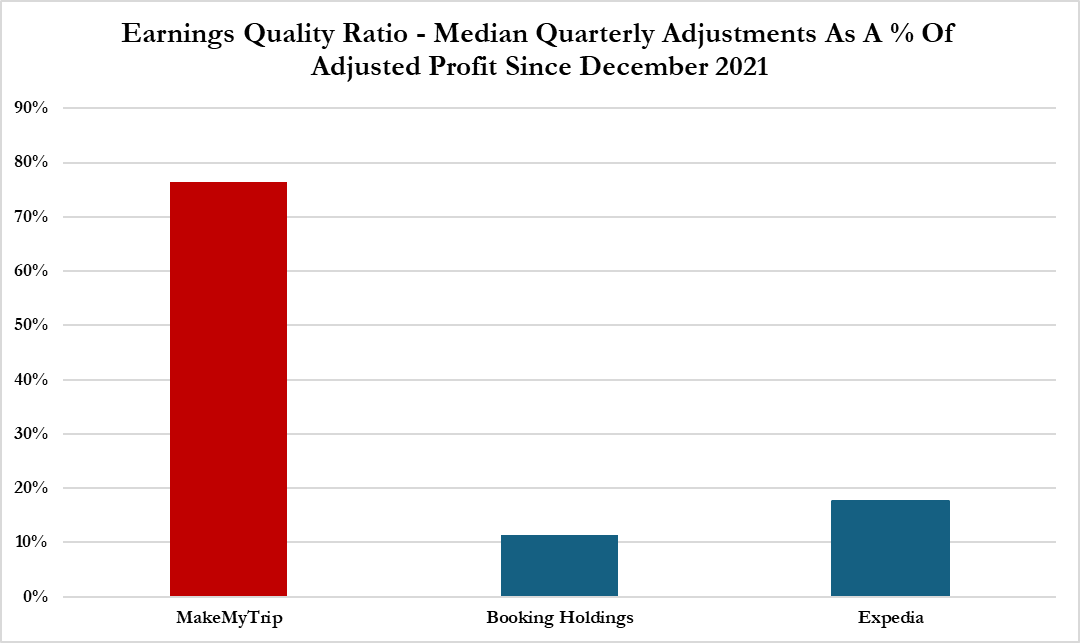
- MakeMyTrip’s adjustments dwarf those of peer companies like Expedia and Booking Holdings. Since December 2021, MakeMyTrip’s “adjustments” have represented 76% of its total adjusted profit on a median basis per quarter, while peers Booking and Expedia’s typical adjustments represent only 11% and 18% of adjusted metrics, respectively.
- In 2025, MakeMyTrip issued $1.4 billion in zero-coupon convertible notes to repurchase shares from strategic investor, Trip.com. The conversion price of the notes is 3x the current market price. Noteholders have the right to force the company to repurchase their notes in 2028. As such, the company might face a cash outlay of $1.4 billion in 2028, 2 years before the notes mature.
Part 3 - How MakeMyTrip Downplays Competition To Shareholders While Losing Market Share In Key Segments
- In July 2025, MakeMyTrip’s CEO, Rajesh Magow, said that the company only “theoretically” competes and that “there is no real other OTA player” in India. We believe MakeMyTrip is downplaying competition, with executives from Booking and its subsidiary Agoda publicly stating last year that “all eyes are on India” and key airlines and hotel operators telling us they are steadily seeing business shift to Booking.
- Our recent interviews with former MakeMyTrip executives and employees told us MakeMyTrip has been “blindsided” by Booking.com and its subsidiary Agoda, which has caused a “price war” that has driven down MakeMyTrip’s hotel commissions from ~35% to as low as ~18%, with one individual telling us: “And this was all because of Booking.com and Agoda.”
- MakeMyTrip’s wallet share within OTAs with Marriott Hotels has decreased from 38% in 2022 to 31% today, while Booking.com’s business with Marriott has grown, according to an industry consultant who told us: “Now, what’s happened is that Booking.com, from 30%, has increased that one to around 36-38%.” Meanwhile, an executive from OYO told us they have seen a 200-300% increase from Booking.com while MakeMyTrip’s business has declined 10-12% over the last 2 years.
- In the most recent quarter, MakeMyTrip blamed its declining air ticket revenue on a flight scheduling crisis from leading Indian airline, IndiGo. Our research indicates, however, that MakeMyTrip is losing market share to competing OTAs as well as direct booking platforms that are increasingly relied upon by airlines.
- For example, Air India is doing more business with ClearTrip, a competing OTA, while MakeMyTrip’s share of OTA business has declined “between 2% to 5%” year-over-year, according to an executive from the airline. They also mentioned Air India’s direct “one-click” AI booking platform, which public reporting indicates is directly aimed at reducing reliance on MakeMyTrip and other OTAs to avoid “significant commissions.”
- We found MakeMyTrip’s major strategic partner and global OTA Trip.com is also entering the Indian market directly and hiring for key roles in India, furthering the likelihood of an exit from its remaining 16% stake in MakeMyTrip. Notably, Trip.com co-founder James Liang appears to be a seller of MakeMyTrip shares. In February 2026, he filed to sell $3 million worth of shares, per SEC filings.
Part 4 - MakeMyTrip Allows “Bad Actor” Hotels To Proliferate Across Its Platform And Fails To Protect Customers
- MakeMyTrip also appears to enable a litany of “bad actor” hotels and fails to protect its customers. We aggregated reviews of 3,679 budget and lower midscale properties across key metro cities of Bangalore, Delhi and Mumbai. We found that, in nearly 10% of cases, travelers reported serious women’s safety issues, extortion, and other shady practices from hotels.
- MakeMyTrip appears to take little action and has failed to delist these properties. A former MakeMyTrip employee told us: “We basically try to say to them that you shouldn’t be doing it again and again, but we actually don’t do it [ban them].”
- In January 2026, MakeMyTrip unveiled its AI-powered “women-focused safety & assurance features” aimed at enhancing “confidence and decision-making for women travelers.” Nonetheless, we found 113 hotels across the 3 aforementioned metro cities that have reviews highlighting women’s safety issues. They remain listed on MakeMyTrip’s platform.
- In one recent example, a couple found a camera hidden in a flower vase facing their bed. After the hotel refused to refund them, the couple reported the incident to MakeMyTrip. We contacted the couple to learn what steps MakeMyTrip took to remediate the situation, and were told that it offered a mere 25% refund. The hotel is still listed on MakeMyTrip today.
- In another example, female travelers reported feeling unsafe at a hotel due to threats from drunk staff and male employees coming to their rooms at 3 am, stating that the hotel is “completely unsafe” for “family and girls.” This hotel is still listed on MakeMyTrip’s website.
- We also found hundreds of examples of hotels extorting customers for more money at check-in, including one Bangalore hotel where 16 separate reviews describe aggressive extortion at check-in. This hotel is still listed on MakeMyTrip.
- Many state tourism authorities require OTAs to only list registered properties. Yet MakeMyTrip continues to allow unregistered properties onto its platform. A member of hotel association FHRAI told us that many unlicensed hotels continue to be featured on MakeMyTrip’s platform. Posing as travelers, we identified multiple examples of listed hotels that could not provide hotel registration numbers.
Part 5 - MakeMyTrip Is Destroying Its Brand Through Dark Patterns, Sham Guarantees, And Withheld Refunds
- Dark patterns are deceptive web designs that trick users into taking unintended action, like hidden fees, misleading advertising claims, or aggressive tactics such as claiming an add-on is “mandatory” when it is not. The Indian government has scrutinized dark patterns, prompting MakeMyTrip to voluntarily “self-declare” to regulators that its platform is free of manipulative dark patterns.
- A classic example of dark patterns is “drip pricing” where the full price is not disclosed up-front and is only visible to the customer on the final check-out page. While peers like Booking.com have designed their user interfaces to include “no hidden fees,” MakeMyTrip continues to utilize drip pricing to deceive customers, including by hiding its convenience fees until the check-out page.
- MakeMyTrip also uses pressure tactics and false claims to induce customers to buy unnecessary add-ons such as insurance, which it claims is “mandatory.” We highlight multiple examples from social media of MakeMyTrip attempting to trick customers into purchasing trip insurance by sending them follow-up messages claiming it is “mandatory.” A former software engineer for MakeMyTrip stated in an online forum that they “coded some of those dark patterns that sell you insurance.”
- In a similar example, MakeMyTrip sends messages to customers claiming it has already booked a cab for them when the customers never requested or booked a cab. In this way, MakeMyTrip attempts to trick travelers into using its preferred car booking partners. A LinkedIn user exemplified MakeMyTrip as a leader “in innovating new dark patterns,” specifically highlighting messages from MakeMyTrip claiming it had already booked a cab for them once they landed at an airport.
- In another example, MakeMyTrip’s train ticket division pushes an add-on insurance product called “Alternate Trip” which ostensibly offers a “3X Refund” if a train ticket is not confirmed. The fine print, which is not visible on the page where this add-on is offered, reveals that this product is virtually worthless due to numerous restrictions. Claims that “Alternate Trip” is a “scam” are rampant across social media and review sites. A former MakeMyTrip employee told us: “So, that [3X Refund] is also a part of, you can say, a dark pattern.”
- MakeMyTrip has faced a flurry of legal cases, scathing online reviews, and social media backlash related to its opaque refund procedures. TrustPilot’s AI summary of 1700+ reviews reveals "considerable problems with refunds” including “long delays” and “outright denial” of funds. We detail numerous examples of MakeMyTrip’s refund issues in this report, including one example of the company refunding less than 1% of what one customer paid for a trip that he cancelled.
Conclusion
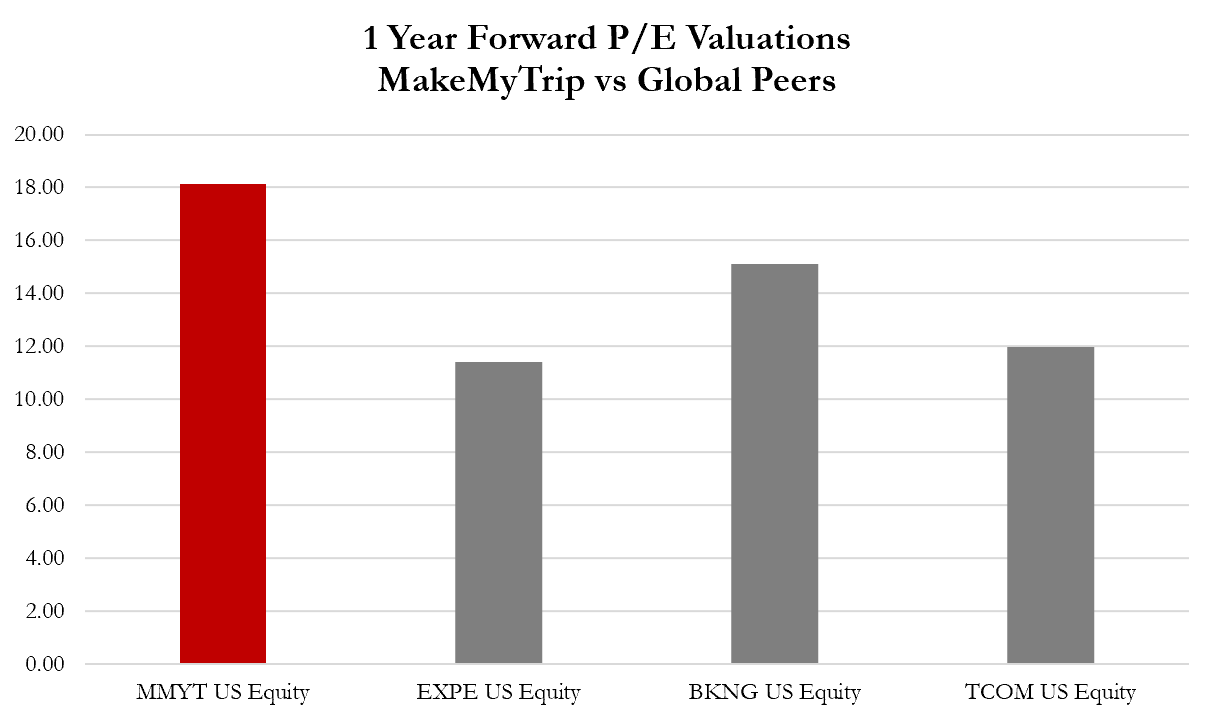
- Even with the recent decline in its stock price, MakeMyTrip remains the most richly valued OTA versus global peers on a forward earnings basis, representing significant remaining downside risk even if one ignores our report entirely. MakeMyTrip trades at 18x forward earnings estimates, significantly higher than the 13x average of its peer group, which includes established competitors Expedia and Booking Holdings.
- Overall, we believe MakeMyTrip is faltering under competitive pressure while attempting to maintain the perception of its market dominance through abusive and anti-competitive practices, aggressive accounting, and the increasingly deceptive extraction of value from its customers whose loyalty, in the words of MakeMyTrip CEO Rajesh Magow, can be lost “overnight.”
Initial Disclosure: After extensive research, we believe the evidence justifies a short position in shares of MakeMyTrip Limited (NASDAQ: MMYT). Morpheus Research holds short positions in MMYT. This report represents our opinion, and we encourage all readers to do their own due diligence. Please see our full disclaimer at the bottom of the report.
Background: India’s Largest Online Travel Platform With 50%+ Local Market Share Across Flights, Hotels, Buses And More
MakeMyTrip Limited is India’s dominant online travel agency (“OTA”) with an estimated 50% + share of the online travel market.[1]
For example, Ambit Capital, an Indian brokerage firm in its “Internet” sector update dated January 20th, 2026 highlights 50-70% online market share across categories. Goldman Sachs’s MakeMyTrip Earnings Review, dated January 22th, 2026, highlights 50%+ share. Videc, a travel and tourism research firm in India, estimates that MakeMyTrip has 55.3% share, per a report in April 2025. ↩︎
Sometimes referred to as the “Booking.com of India,” MakeMyTrip was initially founded in 2000 by Chairman Deep Kalra, completed its NASDAQ IPO in 2010, and today boasts a $3.5 billion market cap.
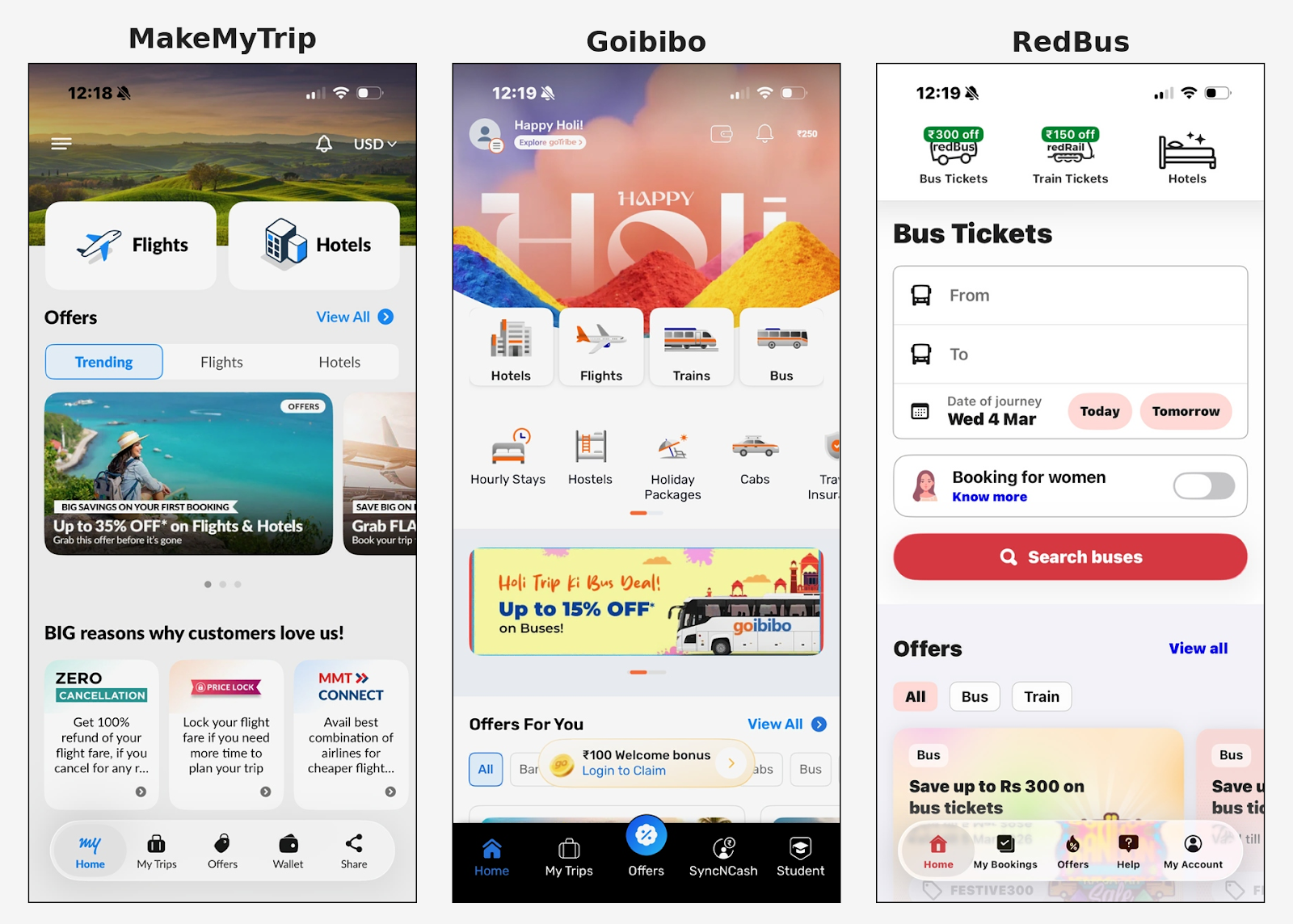
The company generates 94% of its revenue from Indian customers. In its most recent quarter, MakeMyTrip derived 43% of its adjusted margin from selling hotel room nights and 35% from selling air tickets. Its business is conducted through its consumer-facing brands, including its flagship MakeMyTrip platform, its budget-friendly Goibibo alternative, and its bus ticketing app RedBus.
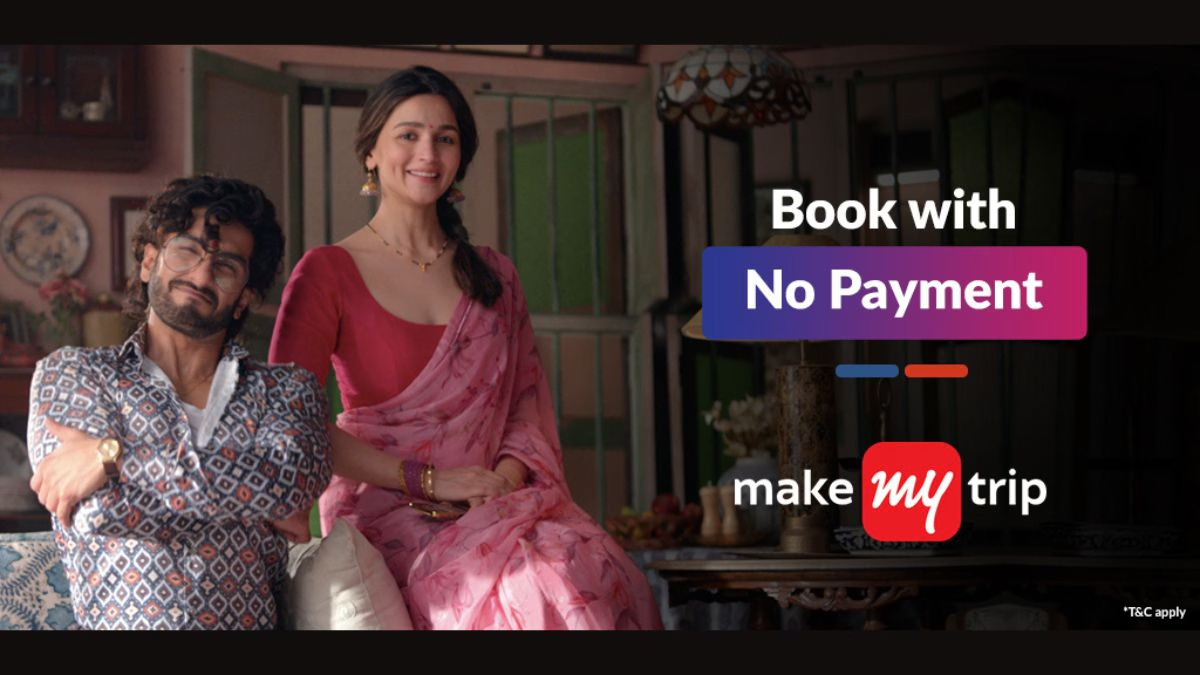
The company is known for using endorsements from celebrities, like Bollywood stars Ranveer Singh and Alia Bhatt, to promote its brand across India.
Bull Case: Technical Innovation Driving Profits At The Dominant Online Travel Platform In India With A Structural Growth Backdrop
After more than 2 decades of losses, MakeMyTrip turned profitable in 2024 while surpassing $1 billion in annual trailing revenue in its most recent quarter with growth fueled by its dominant market position, strategic acquisitions, and a tech-led approach, per Forbes.
Analysts believe MakeMyTrip is a beneficiary of structural growth in India’s travel and tourism market, fueled by a rising middle class with increased disposable income.[1]
JP Morgan initiation report dated September 14th, 2022 highlighted “durable growth in consumer spending” in India as part of its bull thesis. ↩︎
Market estimates imply that MakeMyTrip can continue to grow revenue at between 11-22% over the next 5 years while consistently delivering close to 18% adjusted net income margins, per Bloomberg forecasts.
Meanwhile, all 10 sell-side analysts covering MakeMyTrip have a buy rating on the stock, per Bloomberg, indicating a widespread belief that MakeMyTrip will outperform the market with no counter viewpoint amongst analysts.
Fundamentals: MakeMyTrip Is The Most Richly Valued Online Travel Platform, Trading At ~18x Forward Earnings, A ~40% Premium To Global Peers
Even ignoring the findings of our investigation, which involved interviews of over 100 industry experts, including former company executives, MakeMyTrip trades at a significant premium to global peers like Booking Holdings and Expedia.
Despite the recent decline in MakeMyTrip’s share price, it is still valued at 75x trailing earnings, the highest of any major travel platform, and 18x forward earnings, a ~40% premium relative to its peer group average of 13x.
The significant premium comes in spite of earnings risks tied to a single geographic market, India.
Part 1 - How MakeMyTrip Is Openly Defying Regulators And Doubling Down On Abusive And Prohibited Anti-Competitive Practices
As mentioned, the largest contributor to MakeMyTrip’s adjusted margin metric is the segment of Hotels and Packages. As of the last reported quarter, this segment contributed to 43% of the company’s total adjusted margin. However, it seems that MakeMyTrip’s competitiveness in this space is driven by abusive practices that have been previously penalized by the Indian government.
Despite being penalized by India’s anti-trust regulator and claiming to have amended its practices, our investigation uncovers that MakeMyTrip’s is doubling down on abusive, anti-competitive conduct. At the same time, we found evidence of a more recent, undisclosed investigation into similar practices at MakeMyTrip.
Background: In October 2022, MakeMyTrip Was Fined ~$26.1 Million By India’s Anti-Trust Regulator For “Anti-Competitive Behavior”
The 131-Page Order Highlights MakeMyTrip’s Use Of Abusive Practices, Including Price Parity, Exorbitant Commissions, Exclusivity Conditions, And More
In 2022, the Competition Commission of India (“CCI”), India’s anti-trust regulator, fined MakeMyTrip INR 2.3 billion (~$26.1 million) for anti-competitive behavior, after an investigation that reviewed their practices from 2017 to 2020. [Pg. 15]
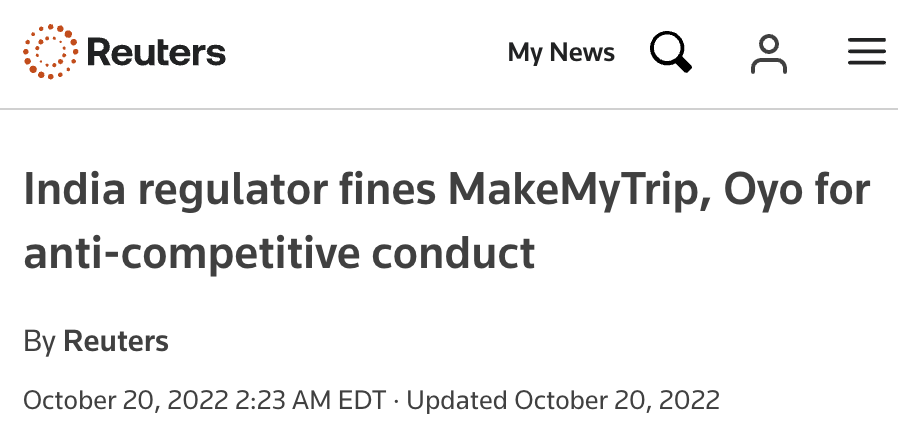
The 131-page order from the CCI primarily focused on MakeMyTrip’s preferential relationship with Softbank-backed hotel platform OYO, but also detailed numerous and far-reaching anti-competitive and abusive practices that MakeMyTrip exploited to maintain its dominant market position.[1]
“MMT-Go” is the platform for hotel and property partners to manage listings, inventory, and rates on MakeMyTrip. ↩︎
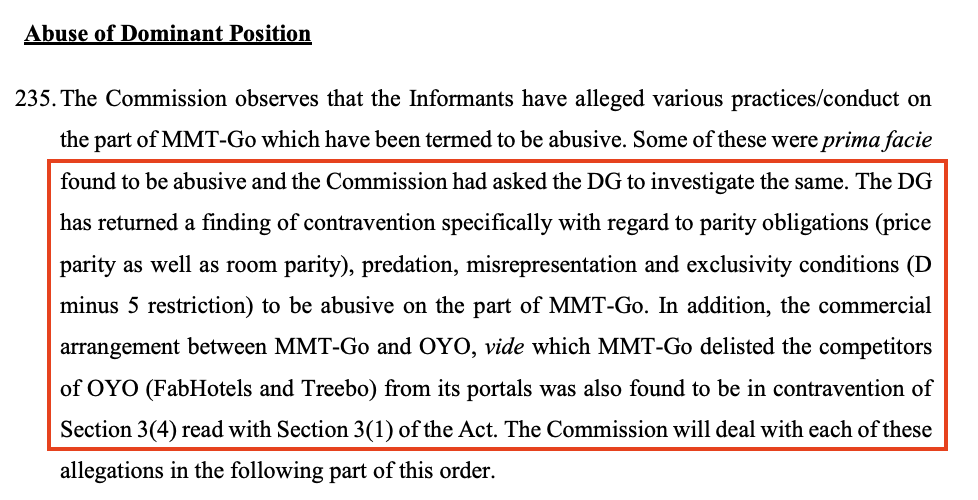
The CCI order noted that it had “wide ranging powers to impose monetary as well as non-monetary sanctions” and imposed the INR 2.3 billion (~$26.1 million) penalty on MakeMyTrip, calculated as a percentage of turnover (5% of total) from 2017 to 2020, while also directing MakeMyTrip to end its abusive practices. [Pgs. 125-130]
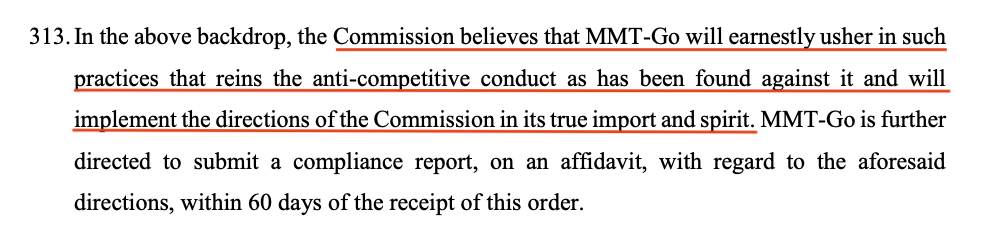
Notably, the CCI order stated that it believed MakeMyTrip would “implement the direction of the Commission in its true import and spirit.”
At the time of the CCI order, MakeMyTrip claimed that it had “voluntarily addressed the issues” highlighted by CCI even before the order and penalty were finalized. [Pg. 127]
More recently, in its annual report, it again confirmed that it has “complied with the behavioral directions issued by the CCI.”
Despite these admissions, MakeMyTrip appealed the CCI decision and the next hearing is expected on April 29, 2026, according to our review of legal records.[1]
Fast Forward To 2026: Our Months Long Investigation Reveals That MakeMyTrip Has Doubled Down On Its Abusive And Anti-Competitive Practices With Flagrant Disregard For Indian Regulators
Despite MakeMyTrip telling regulators it had addressed the issues raised by the CCI order, we identified several continued abusive practices that we believe show flagrant disregard for the CCI order. Corroborating our concerns, we also found evidence of a recent undisclosed regulatory investigation into further anti-competitive practices which we will discuss in more detail below.
In our view, these abusive practices drive MakeMyTrip’s hotel business, which is the primary profit center for the entire corporation while segments such as airline tickets are historically low-margin.
In 2022, The CCI Ordered MakeMyTrip To Stop Imposing “Price Parity” On Hotels, Whereby MakeMyTrip Prohibits Hotels From Selling Rooms At A Price Below That Which Is Offered On MakeMyTrip
Reality Check: MakeMyTrip’s Price Parity Clauses Are Still Widely In Force, According To Former MakeMyTrip Employees, Industry Association Heads, And Hoteliers That Currently Transact With MakeMyTrip
“It Is Still There [Price Parity] … They Got Away With It” — Key Leader From FHRAI, India’s Leading Hotel Association
Price parity is a practice where MakeMyTrip prohibited its hotel partners from selling their rooms at lower prices than those offered through MakeMyTrip, as defined by the Competition Commission of India (CCI). [Pg. 5]
Using that business practice, MakeMyTrip guaranteed it was getting the best pricing available for any given hotel, including relative to the hotel’s own website where customers can book directly.
CCI ordered MakeMyTrip to abandon price parity in 2022. [Pg. 126]
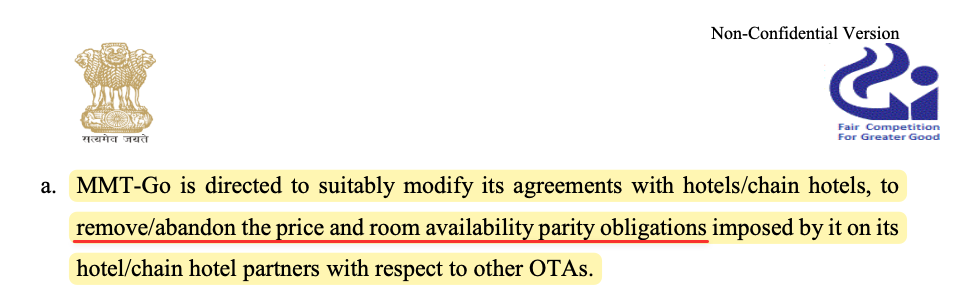
As mentioned, MakeMyTrip claimed it had already "voluntarily addressed” its abusive practices, including price parity and that “no coercive action has been undertaken,” by the time of the CCI penalty. [Pg. 43]
In August 2025, however, an Indian tech policy publication called Medianama reported that price parity clauses “persist” despite the CCI order, specifically calling out an agreement featured on the website of MakeMyTrip subsidiary Goibibo.

Notably, that same agreement became inaccessible just 2 days after the Medianama article was published.[1]
Medianama cited an agreement available on Goibibo’s website. There is an archived version of this agreement as of July 20, 2024 on Wayback Machine. As of August 13, 2025, 2 days after Medianama published the article, an archived version of the link shows the message of “Access Denied.” As of this writing, the URL to the agreement still says “Access Denied” and “You don't have permission to access” the URL. ↩︎
Even with this modest media coverage, we believe shareholders remain in the dark with regard to the prevalence of this practice and the potential regulatory implications for MakeMyTrip.
Former MakeMyTrip employees told us that price parity continues as a standard practice, with one saying price parity is checked on a “daily basis” and another referencing a “parity score” that hotels are held accountable to.
Former MakeMyTrip Director: “On a daily basis. We do parity, first priority parity with other OTAs.”
Former MakeMyTrip Manager: “Once that parity score is met- let’s say I want 90% above parity- and I see that the hotel is converting but is not getting traffic, I will reach out to the hotel… Now, I have forecasted that once I get an exclusive rate from you, I will be able to increase this production.”
We interviewed employees of mid-sized hotel chains that list inventory on MakeMyTrip, each of whom confirmed the practice continues.
For example, an employee at Suba Hotels, a 129+ location chain across India, told us:
“We have a parity clause in the contract where the OTA can go and match the rates.”
“If another player gets aggressive for whatever reason MakeMyTrip might try and like leverage you basically to say you must reduce your rate basically to be competitive.”
Likewise, we interviewed an employee at Pride Hotels, an Indian hotel chain with 35 properties that are listed on MakeMyTrip. They told us price parity was always part of contracts.
Interviewer: I'm specifically asking about price parity clauses.. Is that something that's there or within the contracts?
Pride Hotel Employee: “It [price parity] is always there. It’s always there. Right.”
An executive at OYO, one of the companies mentioned in the CCI judgement, told us that functionally, regardless of whether there was a contractual obligation, they were “obliged” to maintain price parity.
“[Makemytrip] do not call it price parity but ‘price competitiveness score’ because legally they cannot call it price parity…. I think they have some somewhere they've put up the price competitiveness into the ranking algorithm… So even without any contractual obligation, if I'm losing my ranking and business on Makemytrip, I then become by themselves obliged to give them the similar prices.”
We also spoke to a leader at The Federation of Hotel & Restaurant Associations of India (“FHRAI”). The FHRAI is India’s leading hotel industry association and has been a vocal critic of MakeMyTrip and other OTAs since as far back as 2018. It was a key party in the CCI’s 2022 case against MakeMyTrip.
We asked the FHRAI leader about whether the practice of price parity continued after the 2022 CCI order, and they told us “it is still there” and that MakeMyTrip “got away with it” by ignoring the regulators.
Price Parity Appears To Be Partially Enabled By Large Deposits To Hotels To Guarantee Exclusive Pricing & Inventory Access Through A Practice Known As “Money In The Bank,” Or MIB, Per Former Employees
“Again, Officially That Is Not Permitted … It Could Amount To A Monopolizing Situation.” — Former MakeMyTrip Leader
The practice of guaranteeing most favourable pricing and inventory appears to be at least partially enabled by “Money-in-the-Bank” (“MIB”), a tactic by which MakeMyTrip makes cash advances to hotels in exchange for room nights inventory.
MakeMyTrip discloses an “MIB” program in its listing policy, stating that it is “important” for hotels to provide sufficient inventory to “enable utilization of advance amounts paid.” It stresses, however, that the agreement should not be construed to mean that the hotel must “exclusively” provide inventory to MakeMyTrip.
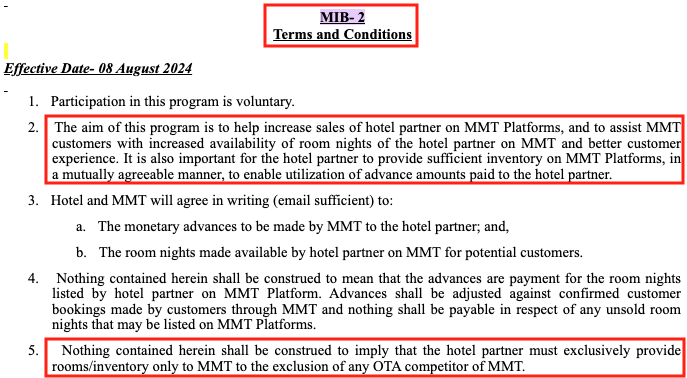
Despite MakeMyTrip’s disclosure that the agreement is not aimed at securing exclusive inventory, former employees described it that way during our interviews, with one calling it a “quasi exclusive arrangement for these benefits and rates.”
The same former executive explained the strategic importance and benefits of MIB for the company, seemingly enabling exclusivity and price parity. They explained two key features of MIB:
"One is that we get exclusive buy rates that nobody else in the market gets, because we therefore get 2-3% extra. Second is we get inventory guaranteed during peak season. So New Year's, Christmas, Diwali, long weekends, there is guaranteed X percentage of inventory that is earmarked for MakeMyTrip without it being openly known, because these are monopolistic practices, so you can't do that openly.”
Former MakeMyTrip employees were clearly aware that the situation was in a legal gray area and was not officially permitted, especially at large market players like MakeMyTrip. One former employee told us, “Officially, you cannot buy inventory.”
Interviewer: [MakeMyTrip] advance a certain amount and be sort of first in line… when the inventory becomes available, is that the standard model?
MakeMyTrip former leader: “Again officially that is not permitted… So it's a little gray area because it's a bigger market player. So it could amount to a monopolizing situation.”
Former MakeMyTrip directors described it as a “fairly common practice” to obtain “exclusive” pricing and “pre-purchased” inventory, putting hotels under “pressure.”
Former MakeMyTrip Director #1: “We'll give, say, INR 1 million [~$10,800] to one hotel and we'll ask them to upgrade their inventory and everything, and then we will have an exclusive contract… On the hotel, it's a fairly common practice of investing in a particular hotel and asking for an exclusive pricing."
Former MakeMyTrip Director #2: "It’s a proxy pre-purchase because the hotel partner is always in pressure because he has taken money.”
Relatedly, we are skeptical of the true volume of MakeMyTrip’s MIB deposits to hotels. While the company disclosed just ~$12 million in security deposits to hotels in its 2025 annual report, former employees told us MIB deposits could be up to 30% of MakeMyTrip’s domestic hotel partners and between 15-18% of its international partners.
“That is not going to be more than 30% of the domestic business. And that is not going to be more than 15 to 18% of the international business.” - Former MakeMyTrip Director
“Roughly 1/3 of the domestic properties in terms of GMV share had some form of MIB active with them.” - Former MakeMyTrip Manager
Yet this number likely has significant intra-quarter variation as hotels draw down from these balances as they sell room inventory during the quarter.
MakeMyTrip Can Enforce Compliance With Price Parity By Manually Overriding Hotel-Designated Pricing, Or By Simply “Deboosting” The Visibility Of Hotels Who Do Not Comply, Per Our Interviews With Former Employees, Competitors, And Hotel Operators
“What I May Do Is I May … Just Go And Match The Rates With Agoda Without Permission From The Hotel, Or Put The Same Offer Which Is There” — Former MakeMyTrip Director
The 2022 CCI order highlighted allegations that MakeMyTrip can “in its own discretion” change the prices of rooms listed by its hotel.
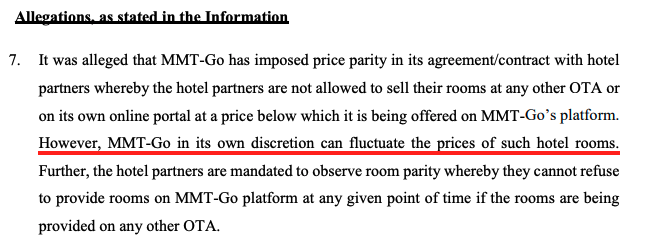
According to a former MakeMyTrip employee, the practice has continued since the CCI order.
“Let's take Agoda [MakeMyTrip’s competitor]. My parity stands at say 70% or or let's say 85% against Agoda… So I'll reach out to the hotels. I'll send them screenshots. I'll mail them and I'll tell them, you know, by evening I need this rectified…. So what I may do is I may, and the hotel is not responding or slow to respond, I may just go and match the rates with Agoda without permission from the hotel, or put the same offer which is there.”
The CCI order also highlighted a form of shadow banning, whereby MakeMyTrip will simply de-rank certain hotels in its search results if they do not comply with price parity.
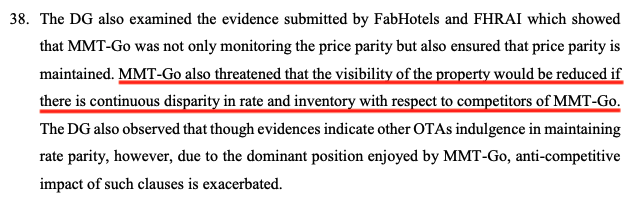
In August 2025, this practice was corroborated by Medianama, an Indian publication that regularly reports on MakeMyTrip and that interviewed multiple hoteliers about how MakeMyTrip allegedly enforces price parity.
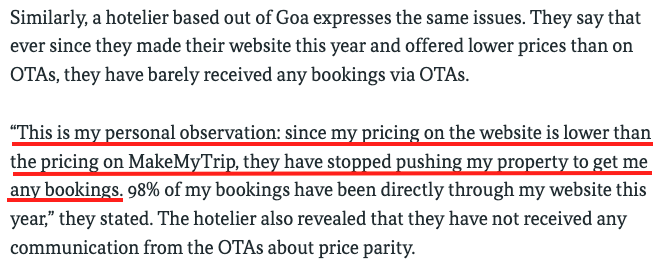
Meanwhile, an executive from competitor ClearTrip told us this “deboosting” practice continues today, specifically noting that MakeMyTrip will deboost hotels who do not agree to exclusively use its platform at the exclusion of competing OTAs such as ClearTrip.
“However, lately, and when I say lately, in the last one week, what we have found out is that they’re [MakeMyTrip] going to our top sellers and they’re saying that, either MakeMyTrip or ClearTrip. Obviously, they can't go ahead and put this on paper, right, but this is what they're saying. And again, going ahead with the deboosting and all the ones who are saying no. So, but yes, there are a lot of hotels who are still holding the fort, who are not 100% reliant on them. But those are certain practices which I would say are not the best of the practices and the right way to go about it.”
The same executive explained that MakeMyTrip will ensure that a hotel is “never going to surface” in search results and that the hotels themselves are often unaware that this is happening.
“‘I will shut your inventory, right, or I will go ahead and I'll put a minimum length of stay,’ The hotel is never going to surface. Forget about in the top 10 or top 15. It's never going to surface. And the hotels, they will also not understand what's happening until a long time, and then they will just call up the market manager and say that you know what happened?”
Unbeknownst To Shareholders, In March 2024 CCI Appears To Have Opened A Currently Ongoing Investigation Into Whether MakeMyTrip’s Price Parity Agreements Were Part Of A “Hub-And-Spoke” Conspiracy
A Leading Legal Expert In India Told Us: “Yes, If It’s True, It Is Serious For One Reason: A Hub-And-Spoke Conspiracy Is Looked At Under The Cartel Offense Under Competition Law… It Is Deemed To Be Unlawful”
In March 2024, the CCI appears to have opened a new investigation into whether MakeMyTrip’s price parity agreement were part of a “hub-and-spoke” conspiracy, with an initial report from the Director General due in early 2026, per a peer-reviewed paper published in the International Journal for Multidisciplinary Research (IJFMR).[1]
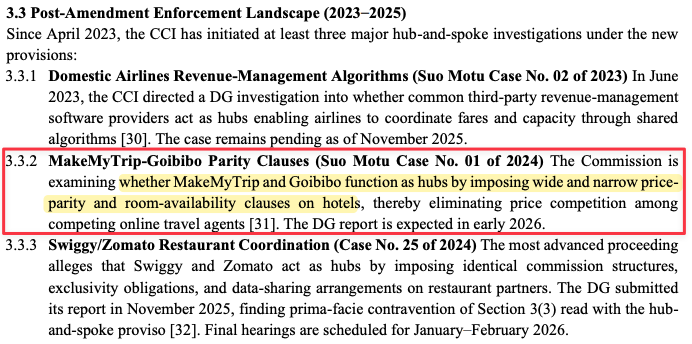
The CCI website also confirms the existence of an investigation matching the case number mentioned in the paper, although it does not specify the parties involved.[1]
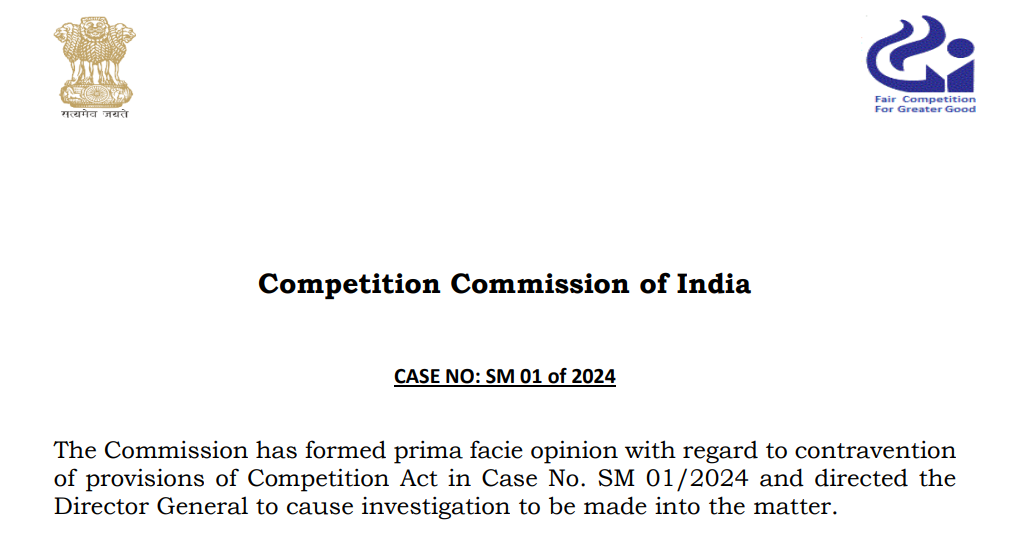
We asked a leading Indian legal expert about this case and, while they were unaware of this specific investigation, they explained that “hub-and-spoke” investigations focus on schemes where competitively sensitive information is shared from a “hub” to preferred “spokes” in order to “effectuate anti-competitive outcomes.”
“That’s quite interesting because I have not come across this but let me explain what a hub-and-spoke is … so different hotel chains are competitive to each other for the same user … Now, if there’s information exchange that is taking place that is competitively sensitive information that is being exchanged to a third party, the third party which is not a competitor, that third party would serve as the hub, and the competitors would be the spokes. So there is a vertical relationship, or typically a vertical relationship, between the hub and the spokes in order to effectuate anti-competitive outcomes.”
The expert further speculated that this could include a “hub” such as MakeMyTrip sharing competitively sensitive pricing information among hotel partners. When asked if this investigation would concern them if they were a shareholder, the expert said:
“Yes, if it’s true, it is serious for one reason: a hub-and-spoke conspiracy is looked at under the cartel offense under competition law. It is considered, it is deemed, to be unlawful … what the commission just needs to prove is that an agreement took place. It does not need to prove effects of that agreement, say, that there was actually anti-competitive effects that took place.”
To our knowledge, there has been no disclosure of this new investigation by MakeMyTrip or the analysts who cover the stock. We find this concerning given the impact of regulatory scrutiny on other OTAs.
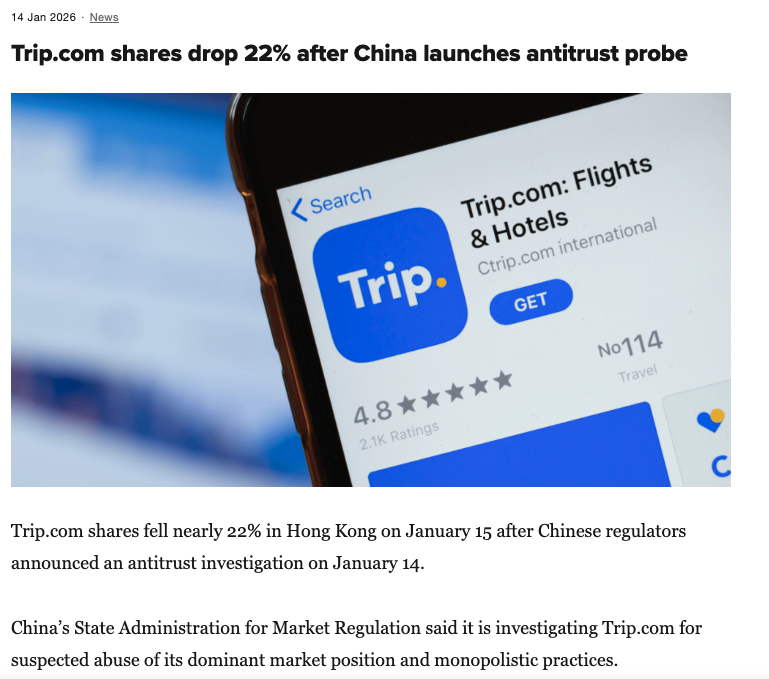
For example, China-based Trip.com’s share price crashed 22% in January 2026 after the Chinese government disclosed an antitrust probe into the company’s suspected “abuse of its dominant market position and monopolistic practices,” according to news reports.
Adding To MakeMyTrip’s Regulatory Risk, The Indian Parliament Is Considering The “Digital Competition Bill,” Which Could Provide The Government With “Significant Enforcement Powers” Related To Anti-Competitive Behavior
An Independent Review Determined That MakeMyTrip Was 1 Of 13 Companies “Likely To Meet To Meet The Threshold Criteria” And A Leading Legal Expert Told Us The Bill Represented A “Regulatory Risk” That MakeMyTrip Investors Should Be “Factoring In”
The Bill Has Not Been Mentioned Once By MakeMyTrip Management Or Analysts During Earnings Calls
In Q1 2024, India’s Ministry of Corporate Affairs released a draft of the Digital Competition Bill (“DCB”) to combat anti-competitive and monopolistic practices from big tech companies that qualify as “Systemically Significant Digital Enterprises,” or SSDEs, as explained by local reporting.
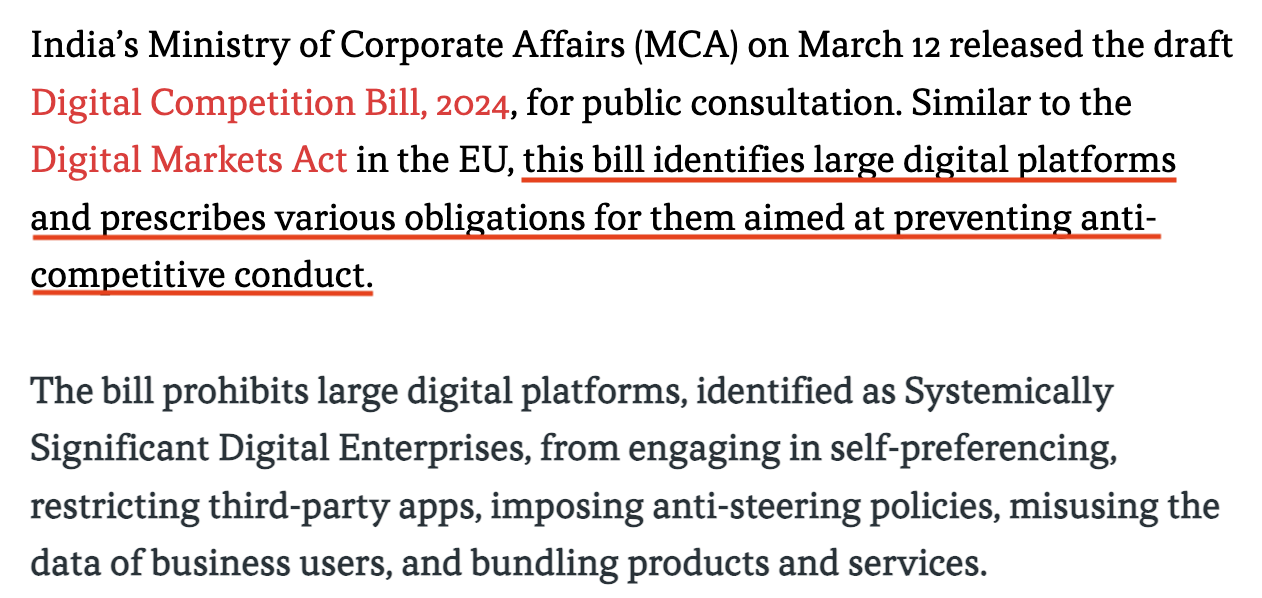
The bill would better equip regulators to combat anti-competitive behavior, including through penalties of up to 10% of annual turnover, per an academic article from the Indian Law Review.
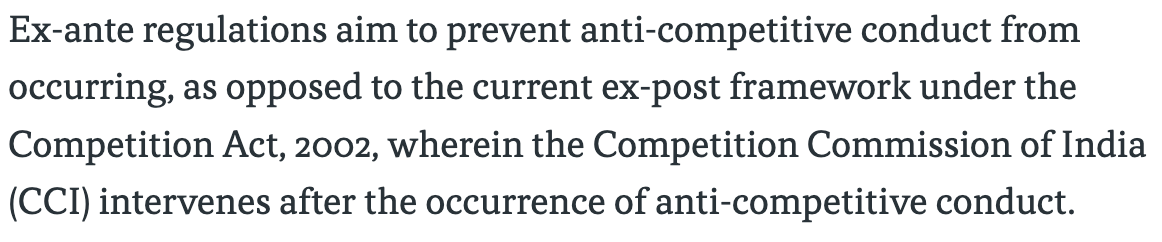
Further, the bill is focused on an “ex-ante” framework whereby anti-competitive conduct is prevented from happening, rather than litigated and penalized after-the-fact, according to local reporting.
The committee that introduced the bill specifically referenced the CCI’s 2022 order against MakeMyTrip, and noted how the penalty still has not been paid due to MakeMyTrip’s ongoing multi-year appeal. The committee stated that for “quicker enforcement,” the CCI should be equipped with the “appropriate tools” to detect and enforce anti-competitive conduct. [Pg. 36, 144, 197]
Furthermore, an Indian think tank specifically highlighted MakeMyTrip as 1 of 13 companies that are “likely to meet the threshold criteria” to be targeted by the proposed bill. [Pg. 6]
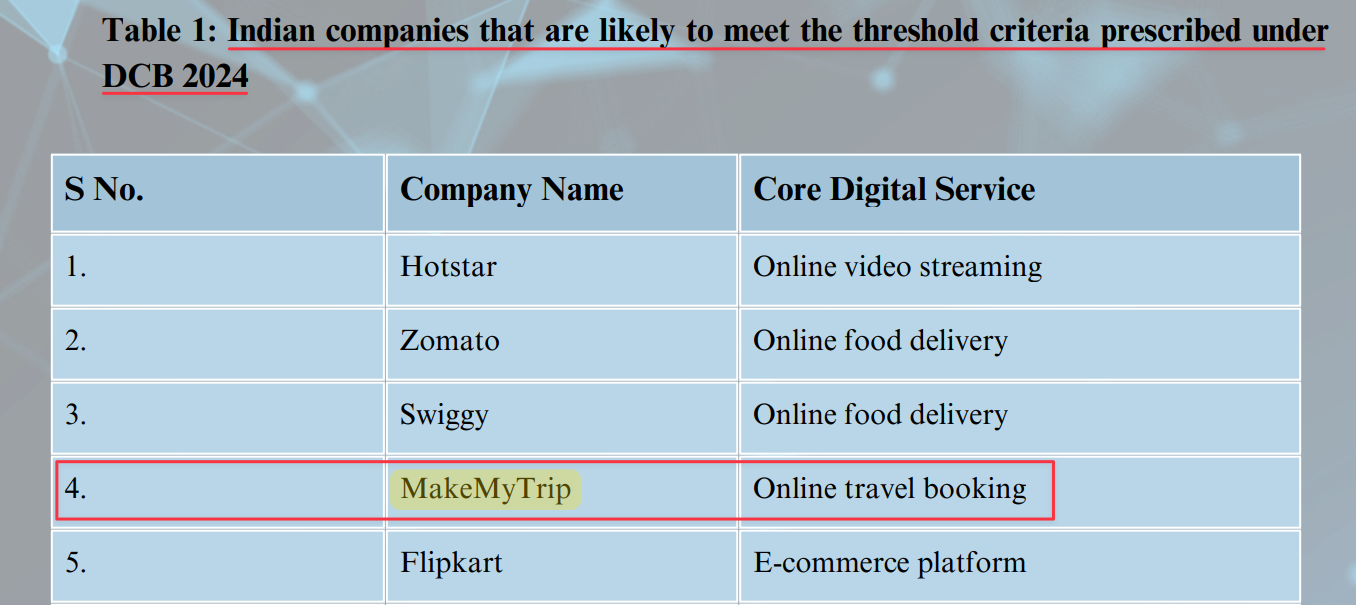
We asked an Indian legal expert familiar with CCI cases about this, and they said it was a “regulatory risk” that we should be “factoring in.”
“The other regulatory risk you should also be factoring in … there is, there was, until very recently, a call by the Government of India, and a committee which gave a report to say that there must be ex-ante regulation of online intermediation services which would include OTAs… these rules can be quite problematic.”
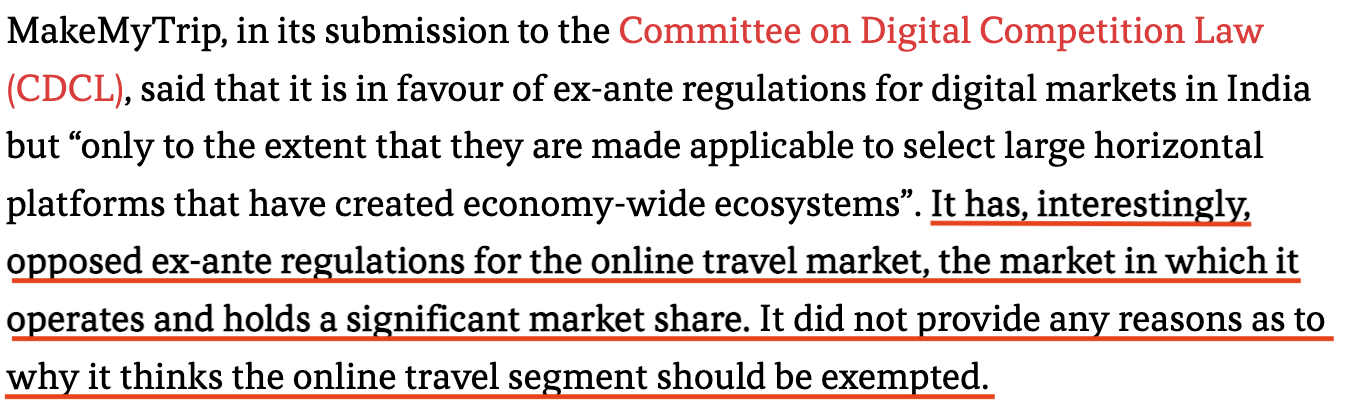
While MakeMytrip claims it is in favor of ex-ante regulations for digital markets overall, it ostensibly believes the online travel segment should be exempt, based on its submission to the Committee on Digital Competition Law (“CDCL”), as reported by Medianama.
Due to pushback from big tech and out of concern for how the bill could impact startups, the bill is on hold while the Corporate Affairs Ministry of India (“MCA”) of India commissions a market study to better understand the bill’s potential impact, per Indian media, which has reported that this study will precede the “final bill.”
The legal expert we interviewed, who was familiar with the Digital Competition Bill, said that the bill in its original form would require “various changes” to MakeMyTrip’s business model.
“Now, the government has withdrawn this bill for the moment and is currently doing a market survey … but in its earlier iteration, MakeMyTrip would have been caught and would have had to undertake various changes to its business model … There would not be any anti-steering provisions, there would not be any self-preferencing, and search rankings must have been fair and they should have been listed appropriately if there were any sponsored links and the likes.”
Despite the potential passage of a bill that would directly target key aspects of MakeMyTrip’s high-margin hotel booking business, not a single analyst has asked a question about the bill during earnings calls, nor has management ever mentioned it on those calls.
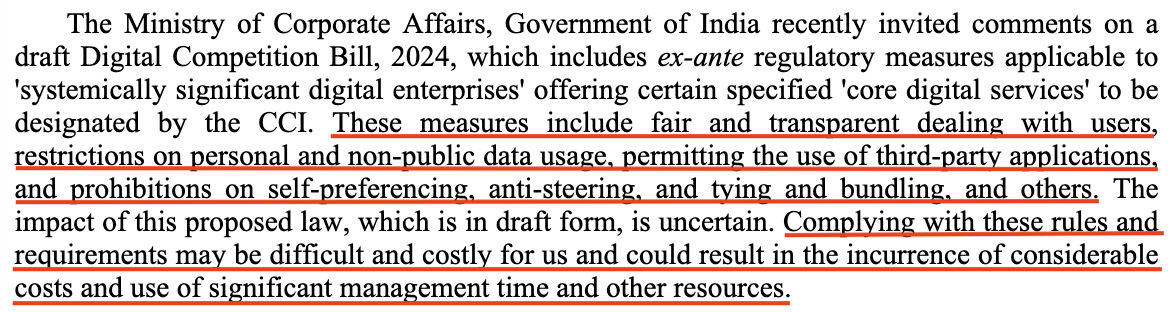
MakeMyTrip’s sole reference to the bill is buried at the bottom of Page 33 of its annual report, where it states that complying with the future bill could be “difficult and costly.”
Part 2 - How MakeMyTrip Obfuscates Its Financial Performance Through Accounting Games
The market believes that MakeMyTrip has turned the corner on profitability and can continue to grow revenue by 11-22% unabated for next 5 years, per Bloomberg market forecasts.
Yet, we find MakeMyTrip’s reported numbers unreliable due to a series of accounting gimmicks. Moreover, we see potential risks equivalent to a full year’s net income, as well as concerns with MakeMyTrip’s inflated adjusted metrics upon which market analysts appear to rely.
Accounting Red Flag #1: MakeMyTrip Has Not Paid 90% Of Its CCI Fine For Anti-Competitive Behaviour, Due To A Years-Long Appeal Process That Appears To Be Close To A Verdict
The Company Has Not Created Any Provision For This Payment, Which Could Be As High As $34 Million— Equivalent To 60% Of The Reported Net Income Of The Last 12 Months
In October 2022, the CCI passed its final order against MakeMyTrip which included a ~$26.1 million penalty. The next month, MakeMyTrip appealed the decision with the National Company Law Appellate Tribunal (NCLAT), which permitted MakeMyTrip to pay a 10% deposit until the appeal was resolved.
In its recent annual report, MakeMyTrip stated that the “final hearing” for the appeal was scheduled for July 2025. As mentioned, however, the next hearing is now scheduled for next month on April 29, 2026, per our review of legal records.[1]
A leading Indian legal expert familiar with the case told us that this balance accrues at 12% annual rate while the case is under appeal, indicating that the remaining balance could have grown up to $34 million.[1]
Assuming a remaining balance of $23.5 million capitalized annually for a period of 39 months. ↩︎
“There is an interest which was, which is on the 90% which has not been deposited, will continue to run. And that interest, it will be interesting to know, to see what interest the commission, if ultimately MakeMyTrip loses, what interest will be applied.
Because the interest earlier used to be 1.5% per month which was 18% per annum. Now it has been reduced to 1% per month which is 12% per annum. So, it would be that amount along with interest will have to be paid in case MakeMyTrip loses before the appellate tribunal.”
Whether or not interest can be applied on an outstanding CCI penalty that is under appeal is a matter that is currently being litigated in Delhi High Court.
While the outcome of this appeal determines whether MakeMyTrip’s remaining payment could be as high as ~$34 million, MakeMyTrip has failed to provision for any expense at all.[1]
MakeMyTrip recognizes provisions from “legal and tax matters” as other operating expenses. Since 2022, when the fine was imposed, the company has only recognized a provision of $4.7 million, related to a legal case with a former shareholder. (1, 2) ↩︎
The remaining payment could represent 60% of MakeMyTrip’s calendar year 2025 net income. [1, 2]
Accounting Red Flag #2: MakeMyTrip Has A $20 Million Receivable From Go Airlines, A Now Insolvent Airline In India
Another OTA Executive On Go Air’s Receivables: “Everyone Has Written Them Off. And There’s No Chance That, Those, Will Be Recover[ed]”
While MakeMyTrip Has Provisioned 50% Of The Go Air Receivable, Its Customers Are Still Due $10 Million From The Insolvent Airline For Flights That Were Booked Through MakeMyTrip
Go Air was a low cost airline in India, owned by the prominent Wadia-family. After consistent losses, credit downgrades, as well as alleged engine concerns, Go Air filed for insolvency in May 2023. It went into liquidation in 2025, per Reuters.
A former executive told us that MakeMyTrip had provided cash advances to Go Air in exchange for discounts.
“So there were two things. One was they [Go Air] are short on cash. They would say, can you give me cash? And instead of paying any interest, I will give you some discount.”
So, after receiving discounted rates on flights and re-selling these to MakeMyTrip customers, with additional markups, fees, insurance, and other revenue-generating extras, the customers are now left holding the bag.
After the insolvency filing, MakeMyTrip reported a $20.9 million exposure to Go Air, including $10.9 million in “refund due to customers,” according to its 2024 annual report.
MakeMyTrip recorded an impairment provision of ~$10 million, according to its latest annual report. The company left the balance roughly equal to the “refund due to customers,” unaddressed. By contrast, other OTA peers like Yatra, said they had made a provision for the “full amount”of its exposure to the insolvent airline.[1]
The original amount recoverable as of March 2024 was $20.949 million. During that year, MakeMyTrip recorded an impairment provision of $10.047 million. The amount outstanding results in a balance of $10.902 million which is equivalent to the refunds due to customers who purchase services of Go Air through MakeMyTrip. ↩︎
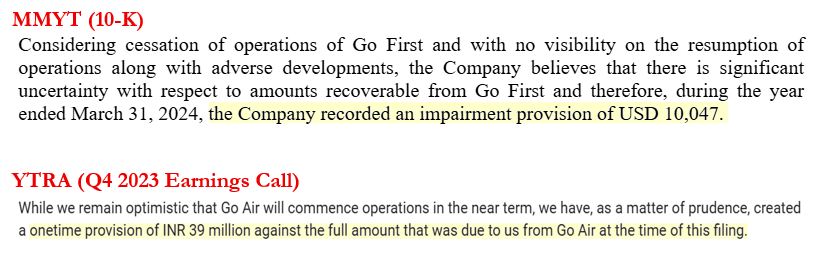
The prospects of recovering any advances from Go Air seem non-existent, as an executive at another OTA, Easy Trip, told us:
"It's in insolvency. All the deposits that have been made, everyone has written them off. And there's no chance that, those, will be recover[ed]."
In a bankruptcy process like this, passengers are among the last in line to get paid below “liquidation costs, financial creditors, employee salaries, government taxes and others,” according to local media. This makes it unlikely that MakeMyTrip will recover any of its customer’s funds.
We see MakeMyTrip’s decision to not provision its full exposure to Go Air as evidence of an aggressive tactic used to manage earnings at the expense of customers.
Lesson Not Learned: MakeMyTrip Has Continued Similar Practices Used With Go Airlines With Indian Startup Airline Akasa Air, To Which It Has “Significant” Advances, Per An Executives
Akasa Air, Which Began Operations In 2022, Appears To Be In Financial Stress. In 2025 It Reported Losses Of ~$210 Million And Has Had Several High Level Executives Depart Recently, Per Media Reports
Akasa Air is an unprofitable start-up airline in India that carried out its first flight in 2022. As of 2025, its “financial stress” has continued to mount with an annual net loss of INR 19.68 billion (~$210 million), per regional news portal AP7AM. Further, key executives have departed the company, including a co-founder last month, according to local reporting.
Akasa had INR 1,964.85 million (~$21 million) in advances from “customers/agents”, per its 2025 annual report, available with the MCA.
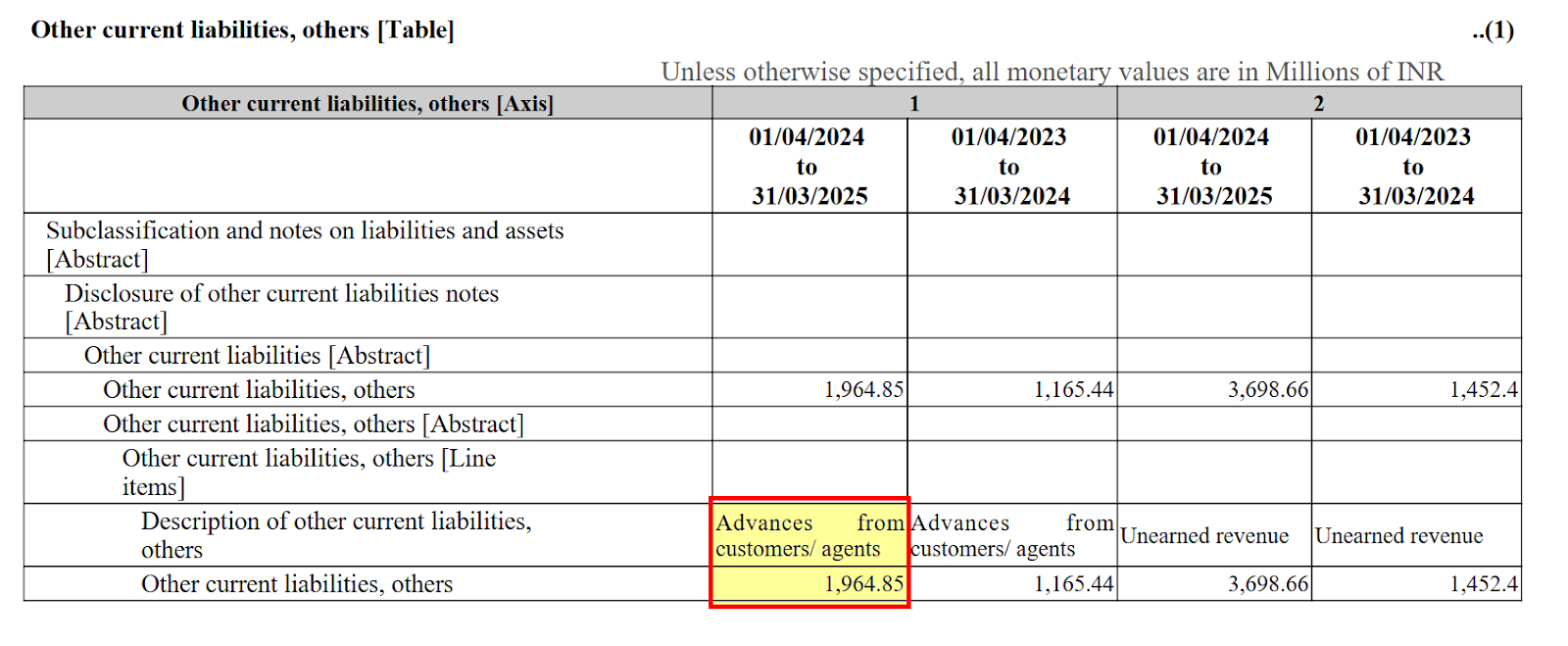
MakeMyTrip appears to have continued similar advances to Akasa that it had with Go Air, resulting in a significant credit exposure to the airline, per a former Makemytrip executive who told us, “Akasa is significant because they give special fares if you give them advances. So, bulk of it [advances] is Akasa.”
An executive from Akasa confirmed this saying MakeMyTrip and others were getting discounts as “deposit incentives” as well as special rates to the B2B/corporate channel.
They specifically mentioned that they were over-indexed to MakeMyTrip:
“[Akasa’s] share of MMT is higher, much more than our capacity share.”
While the former MakeMyTrip executive believed there were “no risks” attached, we disagree. We think the lesson of Go Air is clear: having significant financial exposure to stressed airlines and risking customer ire when things go south, is hardly a model of financial prudence or putting customers first.
We believe MakeMyTrip should clarify its direct, indirect and customers exposures, not only to Akasa, but to other financially challenged domestic airlines like Spice Jet.[1]
By indirect exposures, we mean advances or deposits that are made through “consolidators” or B2B players or other third parties. ↩︎
Accounting Red Flag #3: MakeMyTrip Uses Several “Adjusted” Metrics That Inflate Results Compared To Widely Recognized Accounting Standards
Key Example: MakeMyTrip’s Adjusted Margin %, A Critical Growth Metric, Adds Back In Customer Acquisition Costs To Revenue
Without The Adjustment, Air Ticketing Margins Were Compressed By 10 Bps, While The Company Claimed An Adjusted Margin Expansion Of 90 Bps And Alleged A “Robust Performance” For The Last Reported Quarter
MakeMyTrip relies heavily on sizable adjustments for nearly every key metric it highlights to shareholders.
While some investors may disregard the relevance of adjusted metrics, sell-side analysts who have buy ratings on MakeMyTrip’s stock disclose using these “adjusted” earnings metrics for their forecasting and valuation benchmarking.[1]
For example, domestic brokerage firm Ambit Capital uses Adjusted P/E ratio in its global peer comparison as well as adjusted EPS in its forecasting. Reported date January 23, 2026, page 6. ↩︎
Specifically, the company has pointed investors to 3 critical metrics to determine “ongoing growth.” Two of these metrics are “Adjusted Margin” and its dependent metric, “Adjusted Margin %”, according to its annual report.[1]
“Adjusted margin %” is calculated as “adjusted margin” over gross bookings. ↩︎
The absurdity of MakeMyTrip’s adjustments is on clear display in the definition of “adjusted margin” where it treats “inducement costs,” which are customer acquisition costs, as contra-revenue, and then adds them back in the company’s calculation of adjusted margin, according to its annual report.

Through this creative accounting treatment, MakeMyTrip can claim expanding margins for its air ticketing business when real margins are shrinking.
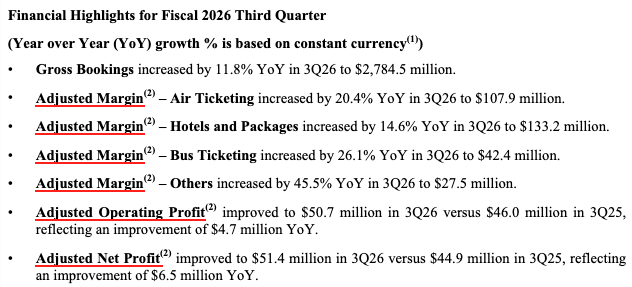
For example, in Q4 2025, for its air ticketing segment MakeMyTrip reported a year-over-year expansion of “adjusted margin %” from 6.1% to 7%, with “adjusted margin” growing from $93.7 million to $107.9 million. During the subsequent earnings call, management said:
“Our air ticketing adjusted margin stood at $107.9 million, registering a year-on-year growth of 20.4% in constant currency. This robust performance was driven by strong growth in international air ticketing business.”
Despite the alleged robust performance, MakeMyTrip's IFRS (International Financial Reporting Standards) air ticketing revenue decreased by 2%, per the company's earnings release. Furthermore, air ticketing IFRS margins over gross bookings contracted, as shown in the table below.[1]
International Financial Reporting Standards (IFRS) are globally recognized accounting standards issued by the International Accounting Standards Board (IASB) to ensure transparency, accountability, and efficiency in financial markets. ↩︎
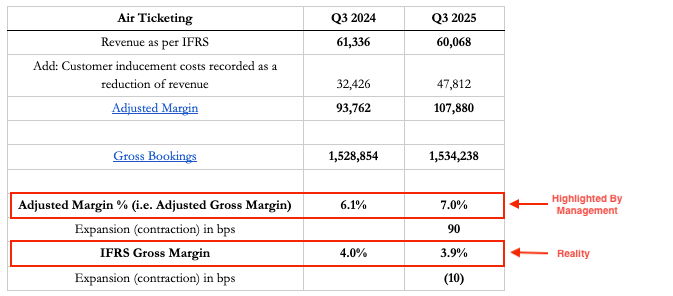
By adding back “inducement costs,” MakeMyTrip is simply engaging in financial engineering to provide the appearance of profitable growth when both revenue and IFRS profitability declined year-over-year, in a material operational segment.
Since 2021, There Has Been A $212 Million Difference Between MakeMyTrip’s “Adjusted” Profits And Its IFRS Profit
In The Most Recent Quarter Alone, IFRS Profit Was $7.2 Million While Adjusted Profit Was 7x Higher At ~$51 Million, A Gap That Is Multiples Higher Than At Peers Expedia And Booking Holdings
MakeMyTrip’s “adjusted” net profit is also a product of substantial add-backs that do not equate to economic reality, like parts of interest expense, share-based compensation costs and losses in investee companies.
For example, in 2025 MakeMyTrip turned an IFRS net profit of $95.3 million into an “adjusted” net profit of $178.2 million through substantial add backs.
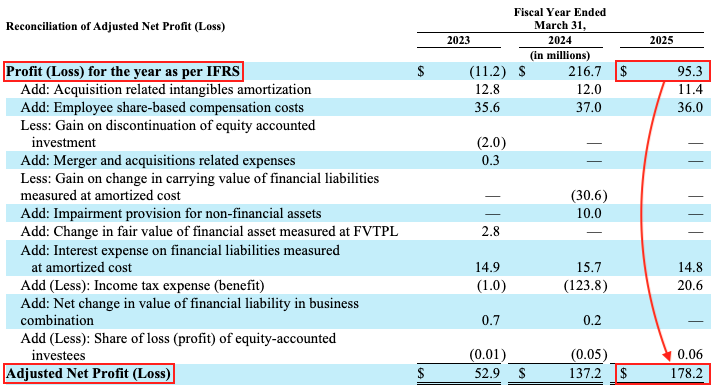
Highlighting the divergence between adjusted and reported profitability numbers, over the last 4 years, there has been a $212 million difference between MakeMyTrip’s adjusted and IFRS numbers.
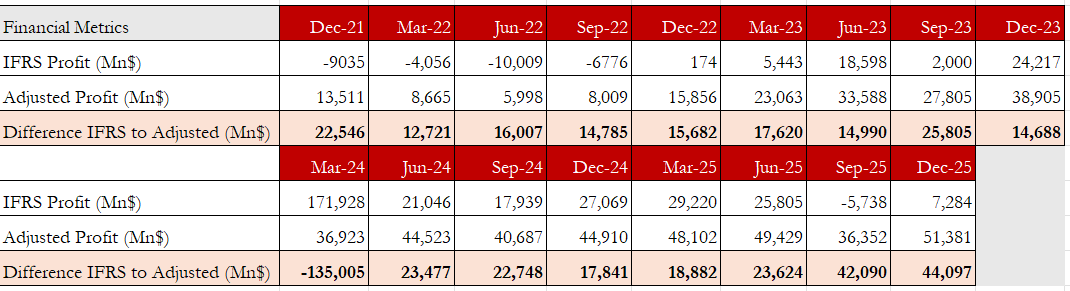
In certain quarters, like December 2022, a mere profit of less than $200,000, turned into a $15.6 million adjusted profit— a 90x increase.
More recently also, the difference is especially pronounced. In its most recent quarter ended December 2025, “adjustments” boosted reported profit by 7x, from $7.3 million to $51.4 million.
As a percentage of adjusted profit, these adjustments are significantly higher than the typical adjustments from global peers Booking Holdings and Expedia over the same period. On a median basis, adjustments accounted for 76% of MakeMyTrip’s quarterly adjusted profit, vs only 11% and 18% for Booking Holdings and Expedia.
In June 2025, In Order To Provide A Partial Exit To Strategic Investor Trip.com, MakeMyTrip Raised $1.4 Billion Through Convertible Notes With A Conversion Price 3x From Current Levels
Noteholders Have The Right To Force The Company To Buy Back Their Notes 2 Years Before Maturity, Which Could Lead To A Potential Cash Outlay of $1.4 Billion In 2028
Against a backdrop of potential liabilities without provisions, MakeMyTrip might face a major cash outlay in 2028.
In June 2025, MakeMyTrip raised $1.4 billion through a convertible note issuance to reduce Trip.com ’s stake in the company, per the company’s press release. The conversion price into equity is set at $121.50 - around 3x times higher than the current market price.
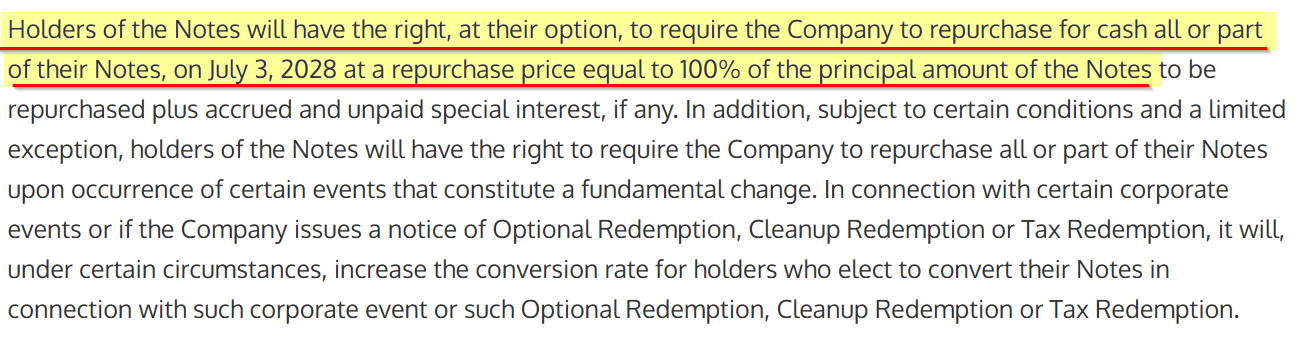
The terms of the note give investors an effective put option, whereby they can require the company to repurchase the notes for the full principal in 2028, 2 years before maturity. This means that in 2028 the company could face a $1.4 billion cash outlay, especially if the stock price continues to remain below the conversion level.
While the company reported $830.0 million cash and equivalents as of the quarter ended December 2025, given the competitive intensity we describe in Part 3 and the current macro backdrop, this remains a significant outlay in the context of the company’s current net cash from operating activities.
Given the situation, we think the company would likely have to replace this zero-interest debt with interest-bearing debt or dilute shareholders by issuing equity.
Part 3 - How MakeMyTrip Is Losing Market Share In Key Business Segments While Downplaying Competition To Shareholders
In July 2025, in response to analyst questions about competition, MakeMyTrip CEO Rajesh Magow downplayed concerns while emphasizing that the business is becoming “stronger and stronger by the quarter” and that MakeMyTrip only has to “theoretically” compete due to its market-leading position. [1, 2]
“I think it will be fair to say the Indian OTA segment, there is no real other OTA player, which has any -- and then lot of them are public and the numbers are out there, are any meaningful. And we continue to -- on a high base, continue to keep growing. And our brand for hotel booking also continues to become stronger and stronger by the quarter.”
“But as far as domestic and international are concerned, we continue to, of course, theoretically compete but continue to lead the show.”
Challenging management’s claims, our channel checks indicate that MakeMyTrip is losing market share with key branded hotel partners such as Marriott and OYO as well as key airline partners, Indigo and Air India, while competitors such as Booking, Agoda, and Trip.com are making inroads in the India market.
We believe market analysts have failed to properly understand this trend because Booking Holdings and its subsidiary Agoda do not report country specific data and market share data is not standardized, allowing management teams and analysts to cherry pick data to fit a bullish narrative.
Further, our channel checks reveal that MakeMyTrip’s corporate travel business – lauded by management for its “strong growth” – is having customer issues and winning business primarily on rock bottom pricing.
While MakeMyTrip Says It Only “Theoretically” Competes With Companies Such As Booking.com & Its Subsidiary Agoda, Industry Experts Say These Competitors Have Started A “Price War” That Is Driving Down MakeMyTrip’s Hotel Commissions And Its Market Share With Key Partners Marriott And OYO
“All Eyes Are On India Right Now” - VP of Asia Pacific, Booking Holdings
“MakeMyTrip Was Blindsided For A Bit With Regards To Booking.com” - Former MakeMyTrip Executive
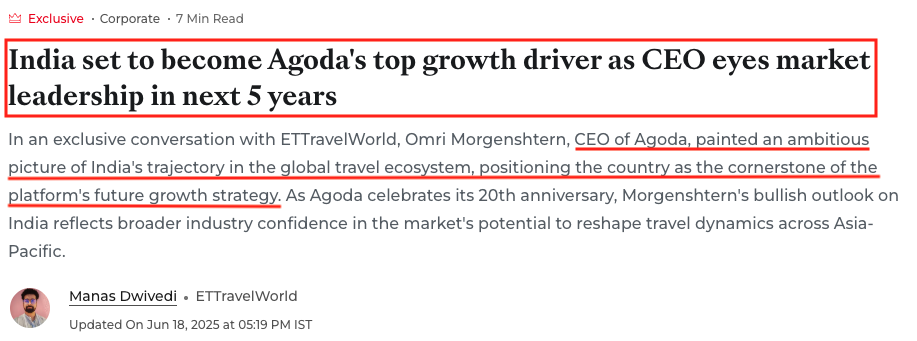
In June 2025, the CEO of Agoda, a subsidiary of Booking Holdings, stated that India represented the “cornerstone” of the company’s future growth strategy.
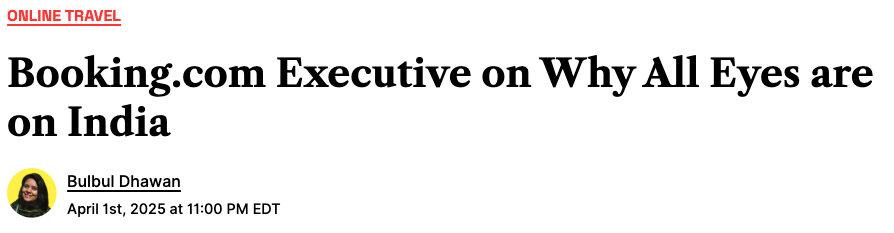
Meanwhile, Booking.com’s VP of the Asia Pacific region stated in an interview last year that “all eyes are on India.”
Despite this competitive threat, as mentioned, MakeMyTrip’s CEO stated in July 2025 that there is “no real other OTA player” operating in India.
Our research indicates the opposite: Booking.com and Agoda’s inroads into the Indian market are having a direct negative impact on MakeMyTrip’s wallet share with key hotel partners, as well as its hotel commissions.
For example, an executive at Booking.com told us that its subsidiary Agoda has ignited a price war with MakeMyTrip over the last 18 months.
“In the last 18 months or so, there’s again been a little bit of a price war type situation, especially amongst, I would say, Agoda, Makemytrip and Cleartrip. You can say that Agoda sort of sparked the whole thing.” — Booking.com Executive
Multiple industry experts corroborated this view, including a former director from MakeMyTrip who explained that pressure from Booking.com and Agoda is translating into reduced hotel commissions.
"I've seen commissions come down from say, 35% - 50%, to 25%... from 25% it came down to, I think 20%, which is now what it is, and it is 18% with certain hotels... And this was all because of Booking.com and Agoda." — Former Director at MakeMyTrip
Another former MakeMyTrip executive told us that the company was “blindsided” by Booking and Agoda.
“[MakeMyTrip] was blindsided for a bit with regards to Booking.com. But Booking and Agoda together, I think of the online domestic hotels market, Booking’s share plus Agoda’s share would almost now be knocking close to MakeMyTrip’s standalone share.” — Former MakeMyTrip executive
We spoke with a manager at GRT Hotels, a chain of 22 hotels, who explained that Agoda is using extremely aggressive discounts to gain market share.
“Agoda has got huge marketing budget…They spend a lot of money they give from their own commission, sometime more than what they earn from us. They give us a discount to the customer to acquire the customer, especially the first time customers. Okay, example. My rate is ₹5,000, Agoda, for a first time customer, he can give a discount of 50%."
These competitive pressures appear to be impacting MakeMyTrip’s “wallet share” with key hotel partners, including OYO and Marriott.
For Marriott, which operates approximately ~200 hotels across India, MakeMyTrip has lost share within OTAs while Booking.com and Agoda have increased share, per an industry consultant we interviewed.
“MakeMyTrip had around 38% [in 2022] … Now, what's happened is that Booking.com [and Agoda], from 30%, has increased that one to around 36-38%.”
The consultant further estimated that MakeMyTrip’s wallet share with Marriott had fallen from 38% of bookings to 31% since 2022 within the OTAs.
Meanwhile, OYO Rooms, one of the largest hotel chains in the world and previously a key partner for MakeMyTrip, has seen a 10% reduction in booking share from MakeMyTrip in favor of Booking.com and Agoda, per an OYO executive we interviewed.
“Agoda is drastically improved … if I talk about 2 years back … India. It was almost like zero. Like less than 1% business from Agoda. Now it is really improved in last 2-3 years. If you see the year-over-year growth, it's like 200-300% growth for Agoda.”
“You can consider this negative 10-12% [share loss] for Goibibo [and] MakeMyTrip together.”
MakeMyTrip’s Air Ticketing Revenue Peaked Last Year. This Failure To Deliver Growth Is Due Not Only To Supply Side Issues But Loss Of Market Share With Key Airline Partners – Including IndiGo And Air India –- To OTA Competitors And Direct Booking Platforms, According To Our Channel Checks
“ClearTrip … Has Actually Gone Up Compared To Last Year … But For MakeMyTrip, We See A Dip Between 2-5%” — Air India Executive
“We Have Managed To Increase Significantly … Our Own Direct Sales” — IndiGo Executive
IndiGo is India’s largest airline, controlling ~64% of the market for domestic flights. Late last year, IndiGo experienced a scheduling crisis that resulted in thousands of cancelled flights and the resignation of its CEO.
In the most recent quarter, MakeMyTrip air ticketing revenue declined by 2.1% year-over-year, which its CEO blamed on IndiGo’s scheduling issues. However, air ticketing revenue has been almost flat since the quarter that ended on September 2024, peaking in the quarter that ended on March 2025.
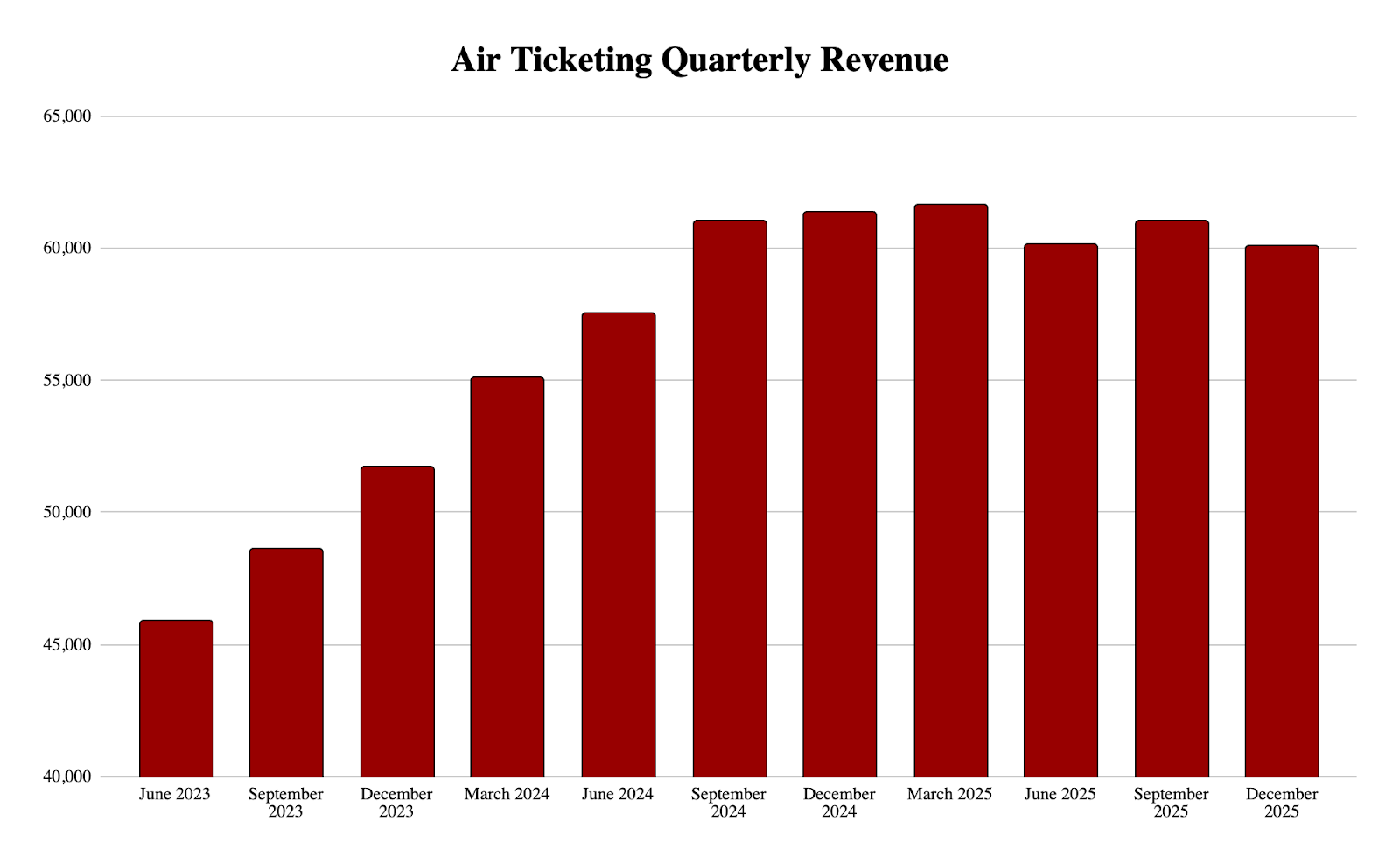
Our research indicates that MakeMyTrip’s air ticketing revenue pressure is also driven by competition from other OTAs as well as airlines investing in their own direct booking platforms that bypass OTAs entirely.
An executive from IndiGo explained to us that the company is focused on direct bookings and that bookings from OTAs have “definitely come down.”
“We do a lot of things to promote our own direct website… So I would tend to agree the OTA percentage mix has definitely come down, but not alarmingly down.”
Meanwhile, an executive from Air India told us that bookings from MakeMyTrip are declining while bookings from competitor ClearTrip are growing.
“ClearTrip, as I mentioned, there has actually gone up compared to last year, but for MakeMytrip, we see a dip between 2% to 5% for the current [year-over-year].”
The executive explained that Air India is compensating for the overall reduction in OTA bookings through its “direct or direct retail channels.”
This view is corroborated by public reporting around Air India’s efforts to build a seamless direct booking channel with the explicit goal of bypassing the “significant commissions” of OTAs such as MakeMyTrip.
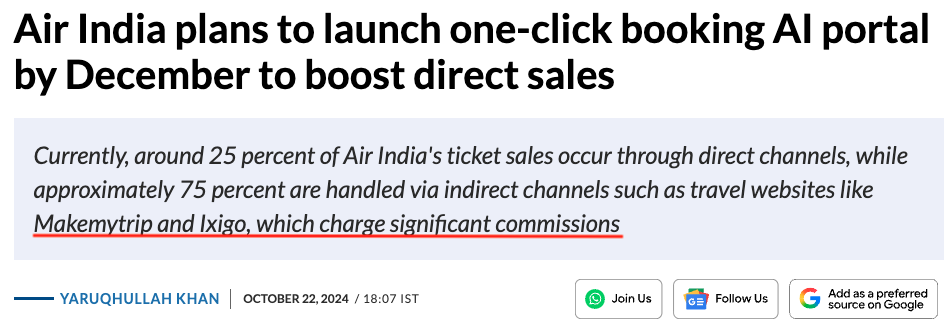
Air India has stated publicly that it intends to grow its direct booking channel from 25% to 50% of bookings.
Meanwhile, IndiGo’s management stated during the most recent earnings call that the company was “revamping” its website and mobile app with a “key driver” being “more direct customer contact.”
“And that's really being received by our customers very positively. What is the key driver of that actually is to make sure that we have more direct customer contact and direct customer interfacing with our customers. We serve over 100 million customers per year. And actually, we would be able to serve them through our digital channels in an even better way today than we have been doing going forward.”
In addition to a direct booking platform for flights, IndiGo is also testing a hotel booking platform that could eat directly into MakeMyTrip’s highest margin segment, although how successful it will be remains to be seen.
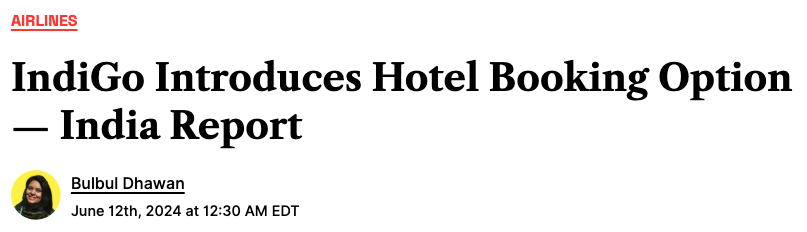
MakeMyTrip Says Its Corporate Travel Division, Representing 10% Of Total Bookings, Is Witnessing “Strong Growth” Due To Its “Technology-Led” Value Proposition
Reality Check: Industry Experts Told Us Key Customers Are Looking For Alternatives And MakeMyTrip Is Attempting To Buy Market Share Through Rock Bottom Pricing
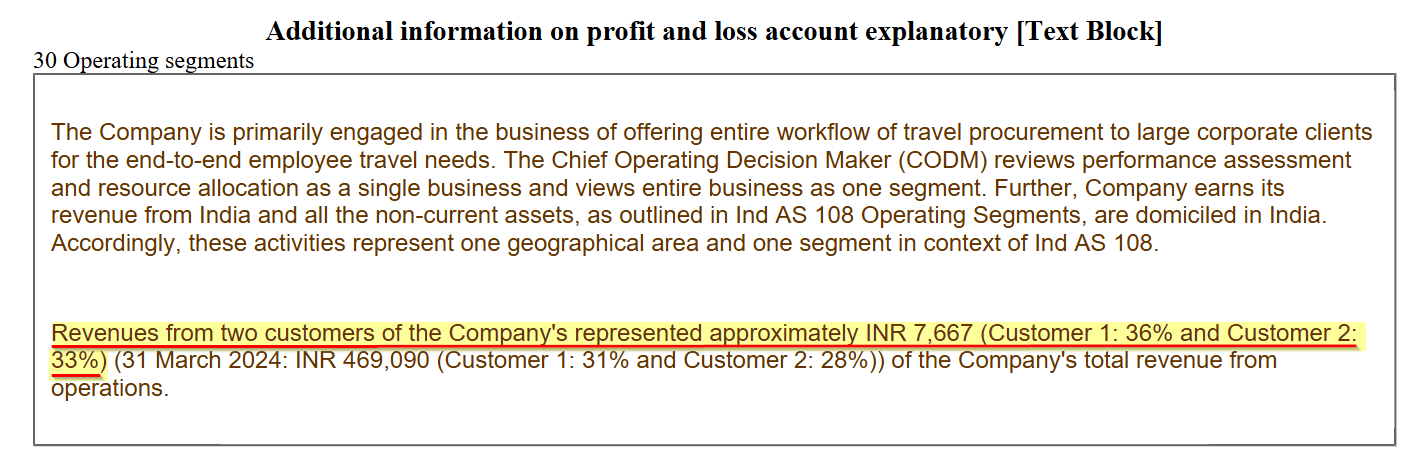
A Key Operating Subsidiary, Quest2Travel, Shows Just 6.8% Margins And Extreme Revenue Concentration With 69% Of Revenue From Just 2 Customers As Of 2025, According To The Subsidiary Annual Report
MakeMyTrip first launched its corporate travel business in 2018 under the “MyBiz” brand. The following year, MakeMyTrip augmented this division with the acquisition of Quest2Travel.[1]
In 2025, MakeMyTrip further augmented this division with the acquisition of the Happay brand, a corporate expense management platform. ↩︎
In October 2025, management credited “corporate customers” for helping deliver “strong overall growth,” and in the most recent earnings call, management reiterated that the corporate division is experiencing “strong growth.”
In February, MakeMyTrip’s corporate travel division had surpassed $1 billion in bookings, equivalent to 10% of total company booking volume, according to The Economic Times.
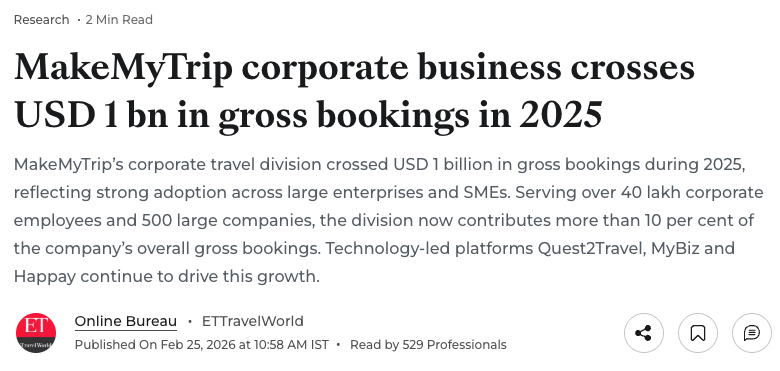
Our research indicates that this division is struggling with key enterprise customers. For example, Grant Thornton, a notable client that was first announced in July 2022, is considering moving its corporate travel business to Yatra, a close competitor, due to MakeMyTrip having failed to meet “basic expectations,” according to an industry consultant we interviewed.[1]
“They [Grant Thornton] are considering Yatra as well. So, but it's a big decision. So changing a travel agency is a very big decision because it involves a lot of stakeholders approvals and all.”
Another industry consultant familiar with the relationship told us Quest2Travel will promise “anything” in its sales process, but fails to meet basic expectations in practice.
"The [sales] person who is bringing these deals is good in convincing, first of all … ‘We can put any policies, we can do anything for you.’”
“I'm talking about at least a basic expectation where one should locate the options, or maybe search the options and ensure that they are offering a best, lowest logical options with a good routing to a client. So that is missing. Yeah, that is completely missing in Quest2Travel and visa [service] is also missing completely.”
While MakeMyTrip does not break out margins for its overall corporate segment, its Quest 2 Travel subsidiary shows Net Profit After Tax Margins of just 6.8% for financial year 2025 per local filings. [Pg. 5]
Given market expectations of net income margins of 15-20%, per Bloomberg, as we previously described, we see scaling up in this channel will invariably come at the expense of profitability.
Its low margins were corroborated by our interviews with industry experts, who told us Quest2Travel competes mainly on economics, or “commercials.” For example, an industry expert told us:
“When they go for pitch, they will … give …very competitive commercials… Sometimes they might go with zero commercials also just to attain that particular corporate. They will go at rock bottom commercials.”
As another headwind for MakeMyTrip’s corporate travel business, Booking.com is targeting the corporate and enterprise space and has launched in India, per our discussion with Booking.com executives.
For example, Booking.com recently entered into a strategic partnership with Indian corporate travel company Thomas Cook India, according to local reporting. Booking.com’s VP of Partnerships stated the partnership would make Booking.com’s inventory “truly enterprise-ready.”
“This partnership with Thomas Cook India and SOTC Travel is a strategic step in making Booking.com’s extensive global inventory truly ‘enterprise-ready’ for the Indian market. By integrating our vast selection of accommodations with Thomas Cook and SOTC Travel’s robust online booking platforms, we are providing Indian businesses with a solution that prioritises transparency, localised services and the flexibility today’s professionals require.”
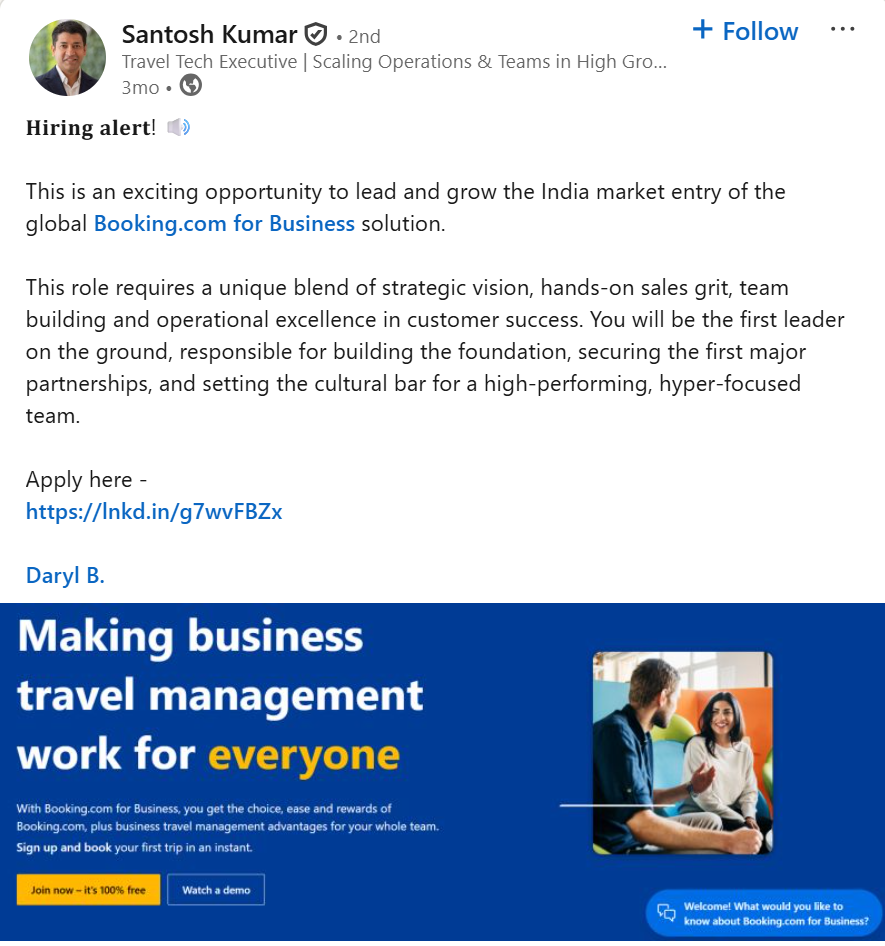
Booking.com also appears to be entering into and about to compete directly in the small and medium enterprise (SME) space in India with its Booking.com For Business solution, per a senior Booking.com employee.
"We are going to be launching our corporate platform [in India]. We would be looking more at the SM [SME].”
At the start of the year, the regional head of Booking.com posted on Linkedin that the business was hiring for a role “to lead and grow the India market entry of the global Booking.com for Business solution.”
As Part Of Its Growth Strategy In Corporate Travel, MakeMyTrip Appears To Be Extending Credit Aggressively, With Its Corporate Customers Receivables Increasing By 68% From 2024 To 2025, While Past Due Receivables Have Increased By 46% During The Same Period
MakeMyTrip’s financial statements also reveal markers of poor earnings quality in its corporate travel business. In 2025, receivables skyrocketed by $33 million or 69% year-over-year, representing 54% of all outstanding receivables for MakeMyTrip.
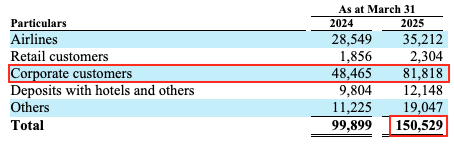
Notably, 45% of MakeMyTrip’s receivables are overdue.
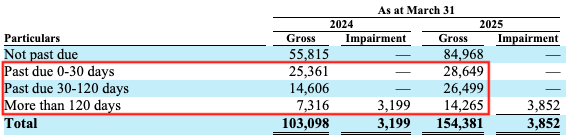
It appears that MakeMyTrip runs a concentrated portfolio at Quest2Travel, despite reporting 539 large corporate clients in its recent earnings call.
Quest2Travel’s 2025 financial statements reveal customer concentration with just 2 accounts driving 69% of revenue, totaling ~$8.3 million.[1]
The financials are presented in lakhs, i.e 100,000. ↩︎
Meanwhile an executive from a peer told us MakeMyTrip’s corporate division - Quest2Travel - would go to “any lengths” on pricing to win business.
“Currently, Quest2Travel could go to any lengths to win a business. I told you, they're very aggressive. So, they’re aggressive with pricing. They're aggressive with cash backs, and they are aggressive with the credit terms as well.”
“In a recent bid that we lost, a large bank where we were bidding, we only lost because they [Quest2Travel] offered a 15% cashback on hotel bookings.” - Thomas Cook Executive
We believe that running a concentrated portfolio, buying market share at rock bottom margins, while extending credit to attract customers, even as that credit appears to be underperforming, is a recipe for disaster.
In June 2025, MakeMyTrip’s Largest Strategic Investor And A Global OTA, Trip.Com, Reduced Its Stake From 45.3% To 16.9% Of Equity
Trip.Com Is Now Entering The Indian Market Directly And The Indian Subcontinent Is A “Key Strategic Focus”, Per A Current Executive, Making Its Current Strategic Investment In MakeMyTrip Untenable In Our View
Trip.com (TCOM US/9961 HK) is a $31 billion market cap travel platform, headquartered in Singapore. It has been a strategic investor in MakeMyTrip since 2016, per its press release.
In June 2025, MakeMyTrip repurchased shares from Trip.com allowing it to reduce its stake from 45.3% to 16.9%, per SEC filings. [1, 2]
At the time, Trip.com said this was part of “efforts to optimize its investment portfolio,” per a press release.
However, Trip.com is now entering the Indian market directly. While reposting a job opening for India, a Trip.com regional director posted on Linkedin that Trip.com was hiring for its “next phase of growth” and “the Indian Sub-Continent remains a key strategic focus for us.”
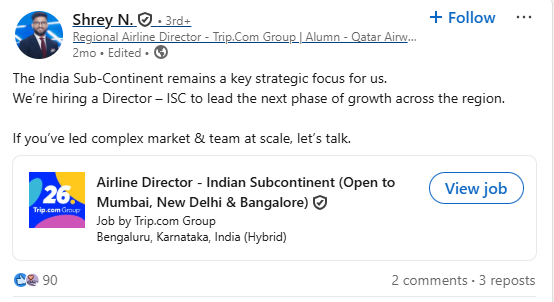
We believe Trip.com’s stated intent to compete more directly in India heightens the risk that it will divest its remaining stake in MakeMyTrip in the foreseeable future.
Notably, Chairman and co-founder of Trip.com, James Liang, appears to be a seller of MakeMyTrip shares. In February 2026, he filed a form 144 signaling his intention to sell $3 million worth of shares, per SEC filings.
Part 4: From Extortion To Unlicensed Hotels – How MakeMyTrip Enables “Bad Actor” Hotels And Fails To Protect Its Customers
After aggregating reviews from thousands of key hotel markets in India, we believe MakeMyTrip leaves its consumers exposed to extortion-like practices, scam tactics, and safety issues at hotels on its platform. Errant hotel owners are often allowed to continue using the platform after being called out.
In its quest to expand its hotel supply, we feel MakeMyTrip has sacrificed basic steps to protect customers.
We Found At Least 332 Properties Across 3 Key Metro Cities Where MakeMyTrip Has Ample Evidence Of Women’s Safety Issues, Extortion, And Other Shady Practices From Hotels, Yet MakeMyTrip Has Failed To Delist These Properties
“We Basically Try to Say Them [Hotels] That You Shouldn’t Be Doing It Again and Again, But We Actually Don’t Do It [Ban Them]” — Former MakeMyTrip Business Development Manager
Negative reviews are a feature of any online platform and there will always be some divergence between the realities of hotel properties and customer expectations.
That said, no online platform should allow outright scamming, deceptive practices or safety threats especially when they are presented with overwhelming evidence on their own site.
For example, Booking.com explicitly says that it does not tolerate “criminal activity or extortion” and that “Any kind of illegal or dangerous activity may lead to having your account and/or property blocked.”
Under the methodology described in Appendix A, we found at least 332 properties in the budget and lower midscale segment in Bangalore, Delhi and Mumbai that appear to be engaging in scamming and deceptive practices, as well as having concerns over women’s safety, according to reviews from 3679 properties.[1]
We define budget to lower mid-scale as 0-4000 INR, consistent with price filters used on MakeMytrip’s website. ↩︎
Most of these hotels are still listed on MakeMyTrip’s website.Former employees told us that MakeMyTrip seldom took proactive steps to delist or ban problematic hotels from its platform. A former MakeMyTrip Business Development Manager told us:
“So, basically, we tell them, if you do this again we basically do strict action and your hotel in which your listing is on MakeMyTrip will not be visible. We basically try to say them that you shouldn't be doing it again and again [bad practices], but we actually don't do it [ban them]...”
A former business head of MakeMyTrip further confirmed the amount of delistings or bans against hotels for these scam-like practices was negligible.
In January 2026, MakeMyTrip Unveiled “Women-Focused Safety & Assurance Features,” Driven By User Content, To Help Women Travelers Choose Their Stays.
We Identified 113 Hotels In The Budget And Lower Midscale Segment In Bangalore, Delhi And Mumbai That Remain Listed On MakeMyTrip Despite Women’s Safety Issues Highlighted In Reviews And Across Social Media
In One Example, A Couple Found A Secret Camera Hidden In A Flower Vase Aimed Directly At Their Bed. After Reporting The Issue, MakeMyTrip Offered A Mere 25% Refund And Continues To List The Hotel On Its Platform Today
In January 2026, MakeMyTrip unveiled “women-focused safety & assurance features” which use “integrated AI, user-generated content, and verified partner data to enhance confidence and decision-making for women travellers,” according to The Economic Times.
Despite MakeMyTrip’s allegedly “AI” powered process to detect women’s safety issues, we found 113 of properties in the budget and lower midscale segment in Bangalore, Delhi and Mumbai where customer reviews indicate serious concerns for female travelers. See our methodology in Appendix A.
One example is Hotel Limon, which is described on MakeMyTrip’s website as a “well-rated 4-star business hotel” that offers “comfortable stays” with “modern amenities.”
Three months ago, a couple stayed there and began to get “intimate” before a “sixth sense” alerted them to an oddly positioned flower pot in the room. Upon further inspection, they found a hidden camera in the flower pot, according to a social media post
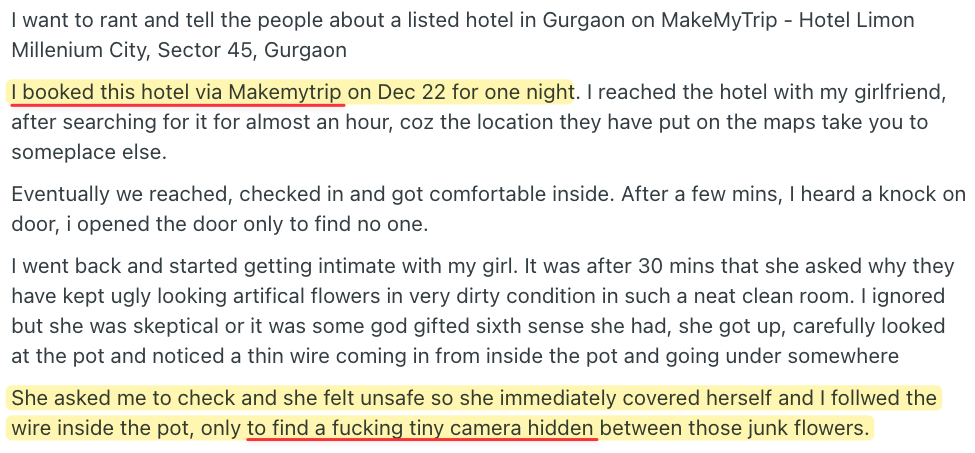
After confronting management, the couple was refused a refund, and stated that they contacted MakeMyTrip to address the issue, according to the post.
We contacted the couple, who told us that MakeMyTrip simply offered them a 25% refund.
“Yes, Mmt got back to me offering a wonderful solution – a refund of 25 percent amount and internal action against them. And I told them to fuxk themselves.”
Today, the hotel remains listed on MakeMyTrip with a “Very Good” 4.2 star rating.
In another example, a hotel called Qotel Comfort has been reviewed by multiple female travelers who claimed that staff visited their room in the middle of the night asking if they were traveling alone. Another review for the same hotel said that the staff should be arrested and that the hotel is “unsafe” for a “family with girls.”
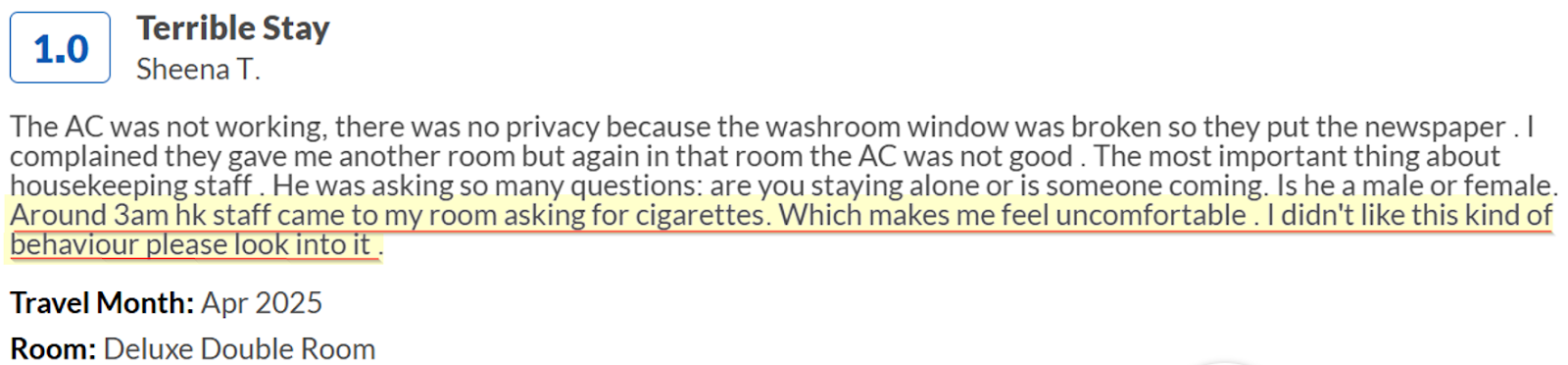
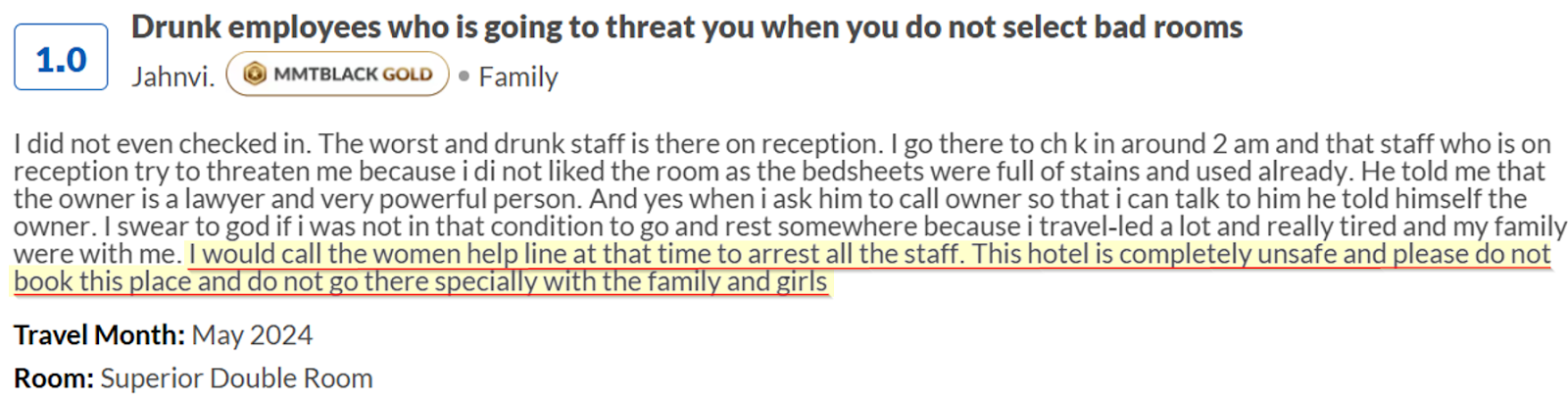
Other reviews for this hotel said there were “no locks on the door” and “no door lock”, hardly an atmosphere conducive for safety at night.[1]
Despite these reviews, Qotel Comfort remains listed on MakeMyTrip with a “Very Good” rating.
In a third example, male employees of the Gateway Inn in Mumbai entered the hotel room of a group of female travelers in the middle of the night without permission. The travelers left a review explaining that they felt so unsafe that they left the hotel at 1:30 am to find alternative accommodation.
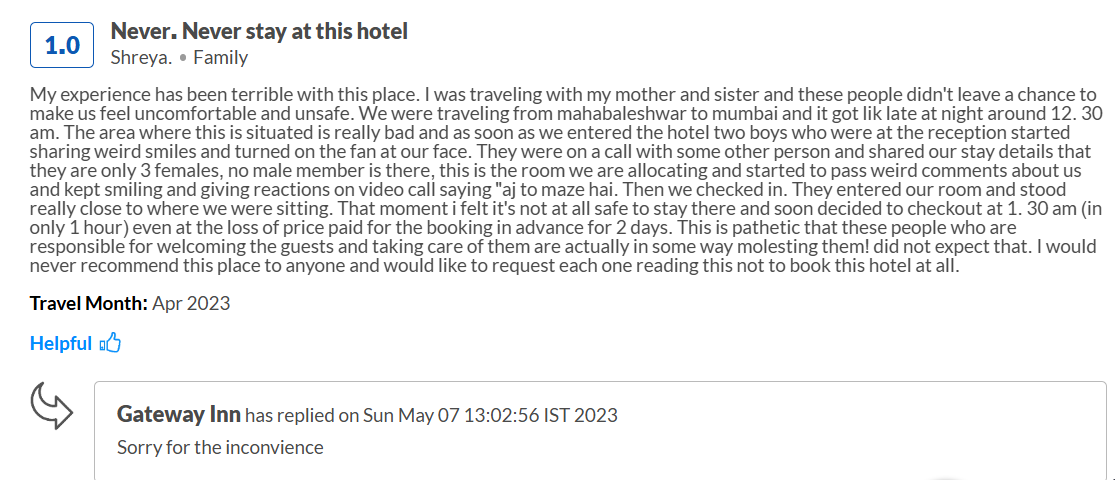
Today, Gateway Inn remains listed on MakeMyTrip’s website with a “Very Good” rating.
We identified a total of 113 properties across Bangalore, Delhi and Mumbai in the budget to lower midscale segment where reviews and social media posts indicate women’s safety issues that should be easily detectable by MakeMyTrip’s “AI” powered software.
We Identified 219 Hotels In Bangalore, Delhi and Mumbai That Extort Customers By Demanding Additional Payments Upon Arrival, Often When It Is Too Late For Travelers To Find Anywhere Else To Stay, Per Customers Reviews
In One Example, 16 Separate Reviews Indicate That A Bangalore Hotel Regularly Tries To Extract Money From Customers At Check-In, Yet The Hotel Remains Listed On MakeMyTrip’s Platform Today With A “Good” Rating
Throughout our research, we found 219 properties across the 3 metro cities of Bangalore, Delhi and Mumbai where hoteliers tried to extract more money from guests upon check-in.
This practice to extract more money, goes beyond the check-in denial. In many cases this was a cross between “bait-and-switch” and extortionary tactics by hotels, per the reviews.
One of the worst examples we found was at a hotel in Bangalore, named O Abhimaani Comforts, which is rated “good,”per MakeMyTrip.
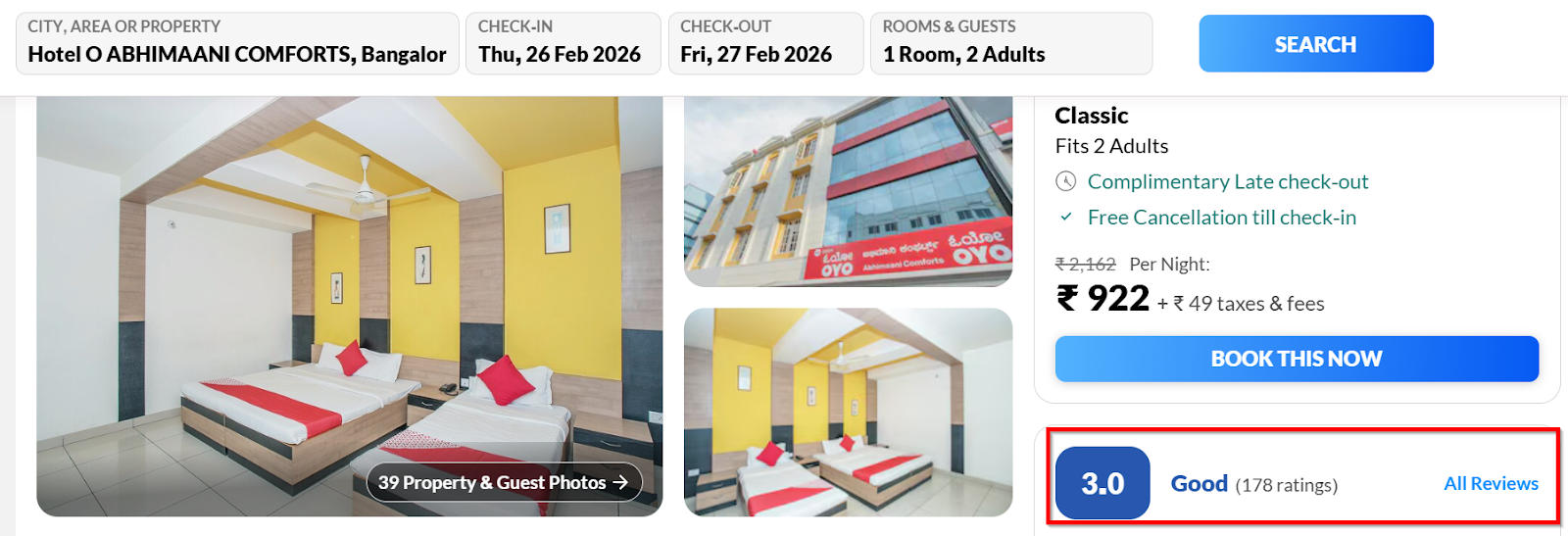
We identified 16 reviews over several years which show the hotel consistently trying to scam and extract money out of guests at check-in. Four of these reviews came from MakeMyTrip “Gold” and “Platinum” customers. [Pgs. 1-5]
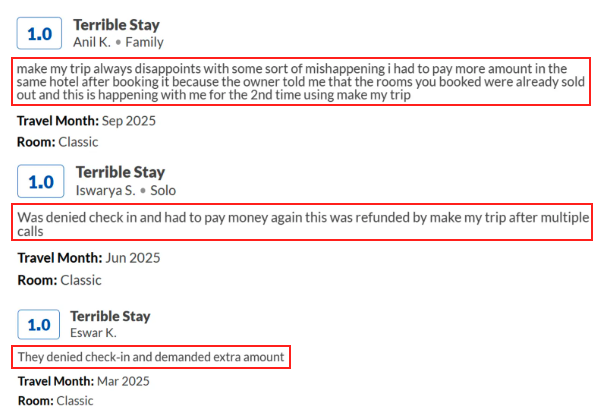
As of this writing, O Abhimaani Comforts remains listed on MakeMyTrip.
Similar reviews can be found on TripAdvisor. For example, one traveler reported a “traumatic” experience at Miracle City Inn, which was booked through MakeMyTrip, according to the TripAdvisor review. The hotel allegedly “demanded” more money upon check-in in addition to other issues.
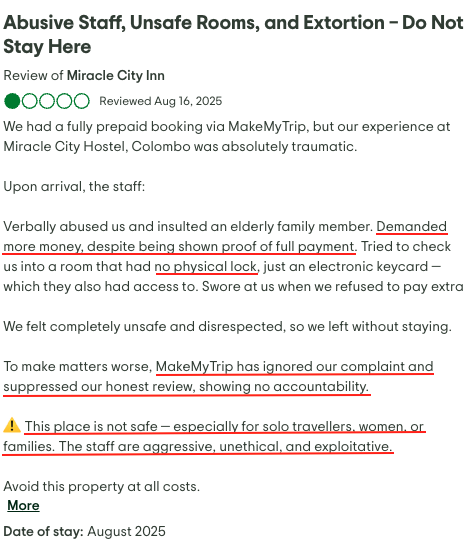
The Miracle City Inn remains listed on MakeMyTrip with a “Very Good” rating – a rating we question given this travelers claim that their review was “suppressed” by MakeMyTrip.
We found evidence of similar issues at the Yes Please Guest House and The Townhouse Ramamurthy, where a combined 18 reviews detail what sounds like extortion, including one traveler who stated that it “felt like extortion in the middle of the night.”


MakeMyTrip appears to have taken no serious action against these hotel operators, as Yes Please Guest House and The Townhouse Ramamurthy remain listed on MakeMyTrip.
A former MMYT employee told us that “1.5% is the average percentage” for “booking denied” which includes the extortion like practices described above. This could mean that 1500+ bookings of MakeMyTrip are experiencing booking denied issues on a daily basis.[1]
Based on 100,000 room nights previously mentioned in local media. ↩︎
Despite Mandates From Certain State Tourism Authorities That Require OTAs To Only List Registered Properties, MakeMyTrip Continues To List Unregistered & Unlicensed Hotels On Its Platform
Posing As Travelers, We Identified Properties Listed On MakeMyTrip That Acknowledged To Us That They Were Not Registered, As Required By State Regulations
Many states in India require hotels to be licensed and registered to operate.
Despite the requirements, the proliferation of unlicensed, unregistered and non complaint premises has made headlines after disastrous fires at hotels and venues [1, 2]
In response to these issues, the state of Goa cracked down on hundreds of unregistered hotels in 2023 for not registering with the tourism department.
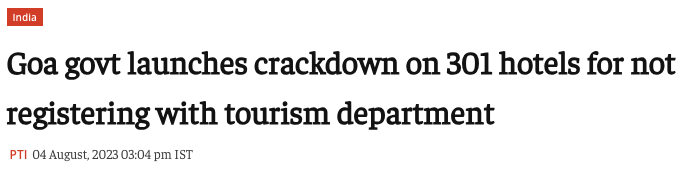
A regional member of the The Federation of Hotel & Restaurant Associations of India (FHRAI) told us that OTAs “amplify the issue” of unlicensed properties, while highlighting the Arpora nightclub fire as a serious risk of unregistered premises.
In 2024, Goa made it mandatory for OTAs such as MakeMyTrip to only allow registered hotels on their platforms. Registered hotels receive a registration number, also known as the DOT registration number.
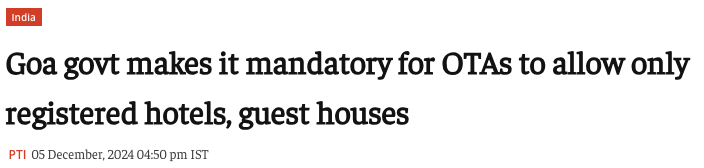
Despite this crackdown, the FHRAI member explained to us that many unregistered hotels continue to be listed on MakeMyTrip in addition to other OTAs.
“[In] Goa there are more unregistered hotels than registered hotels … unregistered hotels are on MakeMyTrip …”
While posing as travelers, we identified several examples of unregistered hotels currently listed on MakeMyTrip.
Example 1: Casa de Calangute is a 3-star guest house listed on MakeMytrip located near a popular tourist destination.
We asked hotel employees for their hotel registration number, and they acknowledged that they did not have one, implying their lack of registration. The property also does not appear on Goa’s updated list of registered properties.[1]
We obtained the contact number from Casa De Calangute from Google Hotels. The latest list of registered accommodation with DOT in Goa available online in Goa’s Department of Tourism was last updated in April 2025. ↩︎
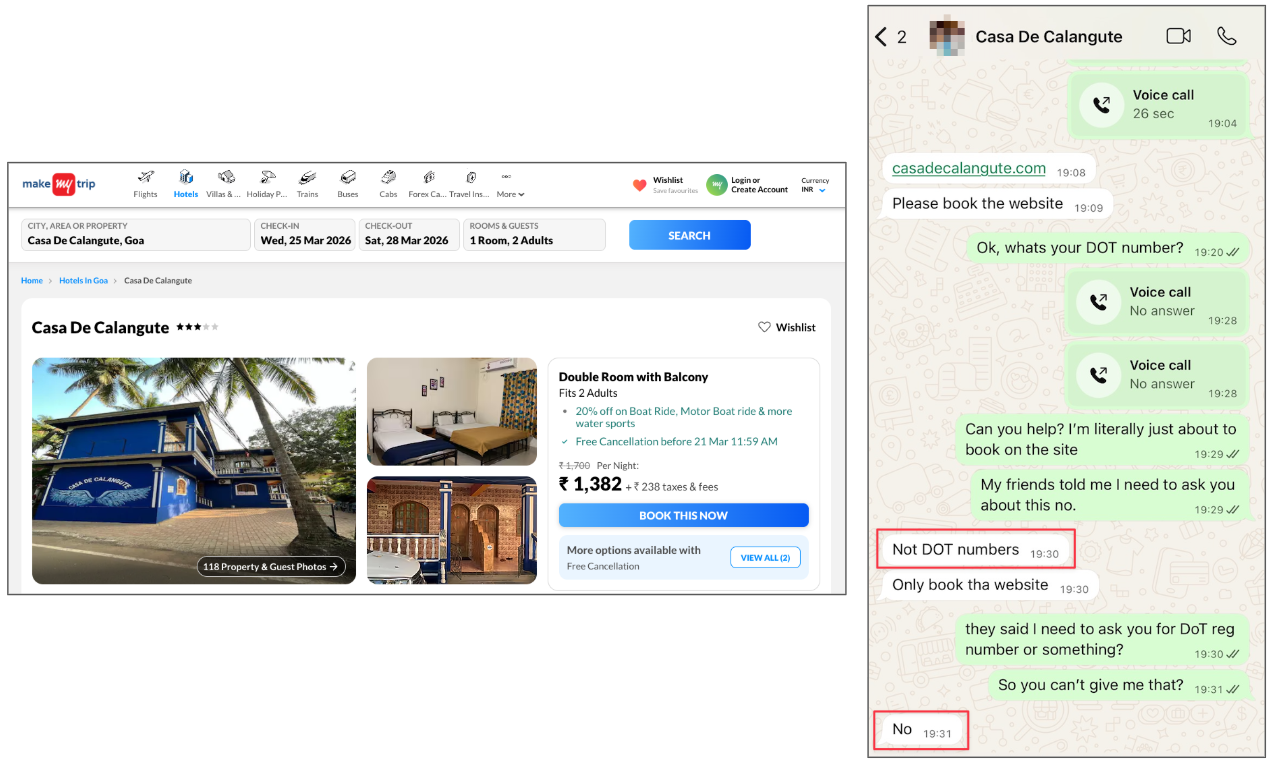
Example 2: Casa Dior, is a luxury 4 bedroom villa listed on MakeMyTrip with an “inaugural offer”, on MakeMyTrip as of March 3rd, 2026. Presumably this is a newly listed property on MakeMyTrip given the offer and the limited number of reviews.
We reached out to the hotel directly under the guise of a corporate booking. When we asked if they had the DoT registration number, they told us they did not, implying their lack of registration.
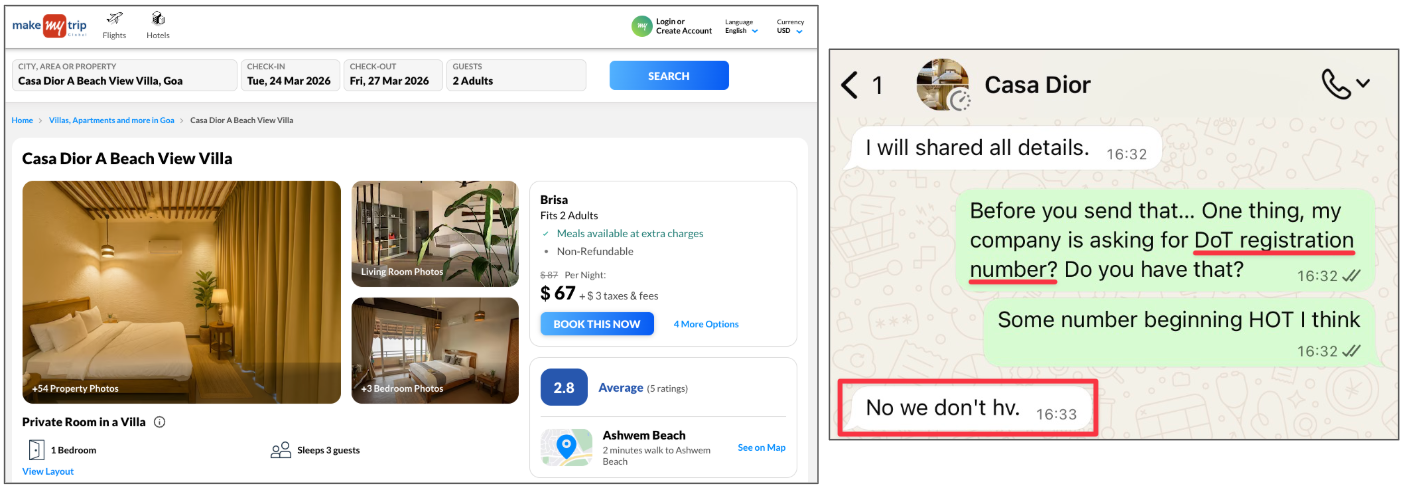
Example 3: Lotus Feet Cottages is listed on MakeMytrip, with 132 reviews as of this writing, a “Very Good” rating, and proximity to a popular beach. The property is not disclosed on the registered properties list, per Goa’s Department of Tourism. When we asked for the property’s DOT registration number, a hotel employee told us: “We don’t have that one.”
As we have shown, verifying if a property complies with regulation is not a difficult task. We see these examples as evidence of MakeMyTrip’s deliberate failure to comply with state regulations.
Part 5 - How MakeMyTrip Is Destroying The Customer Experience Through “Dark Patterns”, Sham “Guarantees”, And Withheld Refunds
MakeMyTrip founder Deep Kalra has stated that Indians are “very loyal” and that once they trust a brand, they will tend to stay with it. He warns, however, that this loyalty can be destroyed “overnight.” We agree.
While MakeMyTrip positions itself as a technology-forward innovator, it appears to employ a variety of underhanded and abusive tactics seemingly designed to extract as much value from its customers as possible, including through the use of “dark patterns”, opaque refund procedures, and add-on products with misleading value propositions.
Background: “Dark Patterns” Are Deceptive Designs That Trick Users To Do Something They Originally Did Not Intend To Do, According To The Central Consumer Protection Authority Of India
Since 2023, The Indian Government Has Issued Several Guidelines To Prevent The Use Of Dark Patterns
The Central Consumer Protection Authority (CCPA) of India defines dark patterns as any platform practice or deceptive design that is meant to mislead or trick users to do something they originally did not intend to do, including through the use of misleading advertising. Some examples are hidden fees or using fake urgency prompts to induce purchase decisions.
Dark patterns have come under scrutiny in India. In November 2023, the government attempted to curb the use of dark patterns by tech companies by issuing “The Guidelines for Prevention and Regulation of Dark Patterns,” which highlighted and prohibited 13 specific examples.
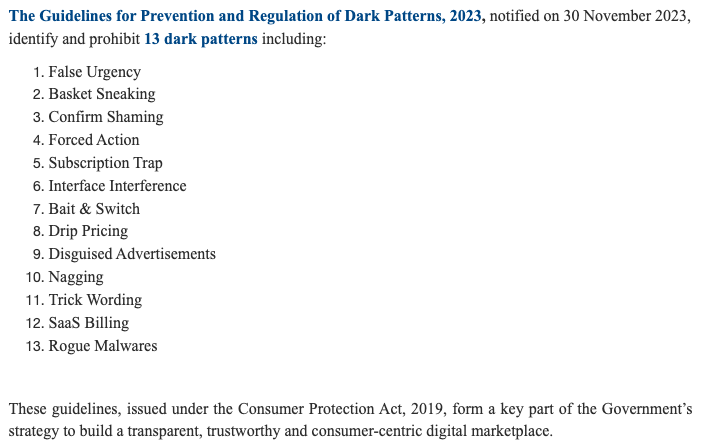
In June 2025, the Central Consumer Protection Authority (CCPA) issued an advisory instructing all online services providers to conduct mandatory self-audits within three months to detect and eliminate dark patterns.
MakeMyTrip Declares Its Platform Free Of Dark Patterns And Claims To Be At The “Forefront” Of Preventing “Dark Patterns” While Purportedly Continuously Monitoring Its Website And Applications Against Them
Reality Check: MakeMyTrip Employs A Variety Of Tactics That Appear Designed To Extract “As Much Value As Possible” From Its Customers, According To Former Employees, Litigation Records, And Numerous Complaints Across Social Media
“In The Codebase, You Will Find Dark Patterns … MMT Has Not Been Caught Yet” — Former Employee In Online Forum, December 2025
In November 2025, MakeMyTrip was among a group of 26 companies that the government called “exemplary” for conducting voluntary “internal self-audits.” All 26 companies declared that their platforms were free from dark patterns, according to the Ministry of Consumer Affairs.
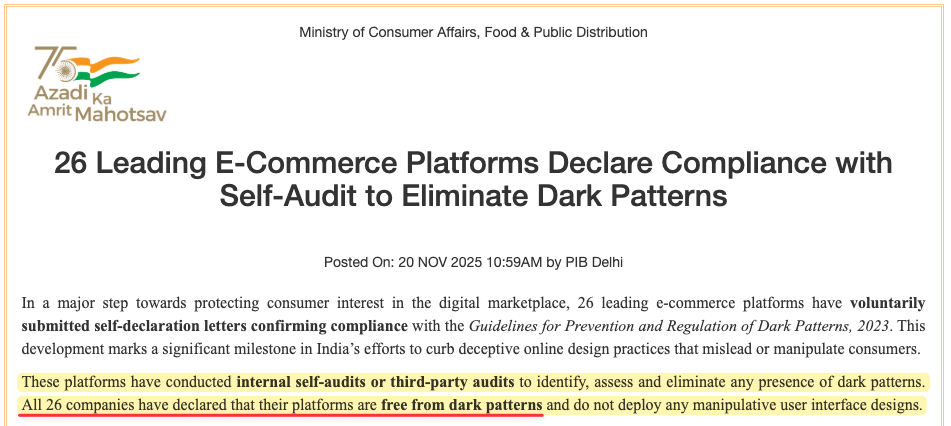
MakeMyTrip’s declaration stated that the company was at the “forefront of implementing the CCPA’s” guidelines on dark patterns and that it works continuously to “guard against any inadvertent dark pattern.”
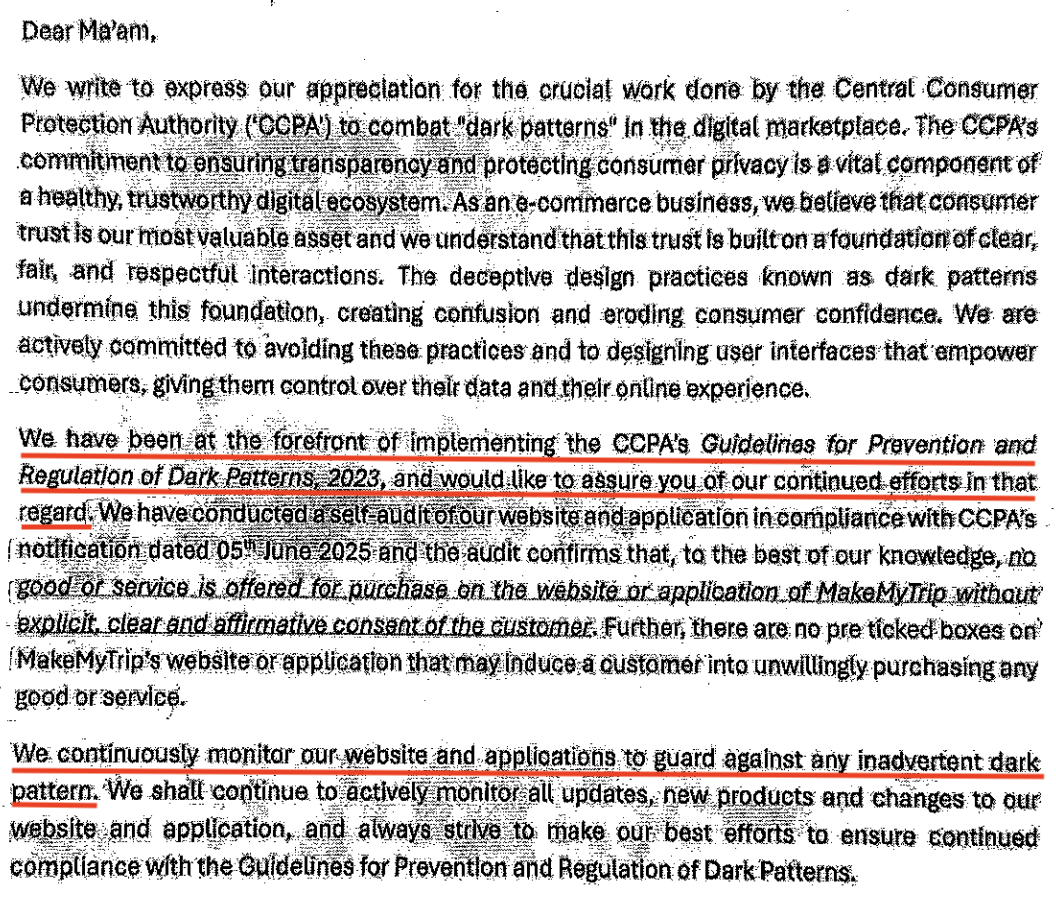
Despite MakeMyTrip’s “internal self-audit” declaring itself free of dark patterns, journalists, and former employees have claimed that dark patterns remain prevalent on MakeMyTrip’s various platforms.
For example, in November 2025, a study found that many of the platforms that submitted declarations of being “dark pattern free” were still utilizing dark patterns. One of the companies highlighted in the study was MakeMyTrip.
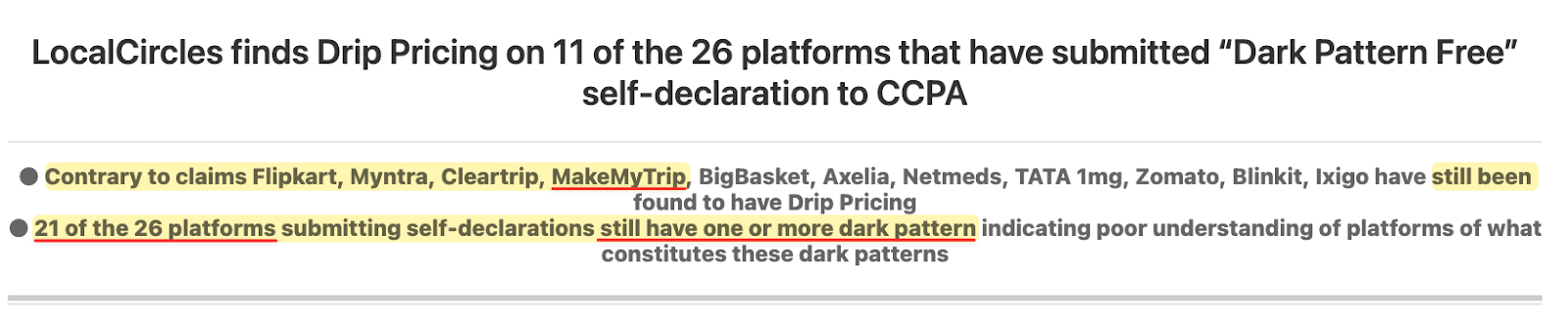
Meanwhile, a former employee posted about dark patterns in an online forum in December 2025.
“Many projects here are designed to extract as much value from customers as possible. The company still survives mainly due to its first-mover advantage; otherwise, it would have struggled significantly long ago. In the codebase, you will find dark patterns, similar to what has been exposed in companies like Zepto (MMT has not been caught yet).”
Dark Pattern Example #1: “Drip Pricing” Is When Hidden Charges Are Not Revealed Up Front, And Only Become Visible To The Customer At The Check-Out Page
MakeMyTrip Does Not Show A “Convenience Fee” Until You Are Asked For Your Credit Card Details To “Pay Now”
The Indian government’s guidelines for identifying dark patterns include “drip pricing,” or deceptive pricing schemes where the full price for a product or service is not revealed up front. [Pg. 10]
The guidelines provide an illustration of “drip pricing” in action in check-out pages for airlines, where the platform “showcases the price as X” but then charges “Y” (a higher price) at the check-out page.
A November 2025 media report highlights an example where a Redditor attempted to book a flight on MakeMyTrip, which increased the initial price by the time the customer got to the “final page.”
“A user booking a flight from Goa to Chandigarh reported a difference between the initial price MakeMyTrip showed them and the price on the final page. They said that the final price was Rs 700-1000 more than the initial price.”
We confirmed this practice ourselves.
We tried to book a direct flight from New York to New Delhi, using MakeMyTrip. We selected the cheapest offer, for $2,205.
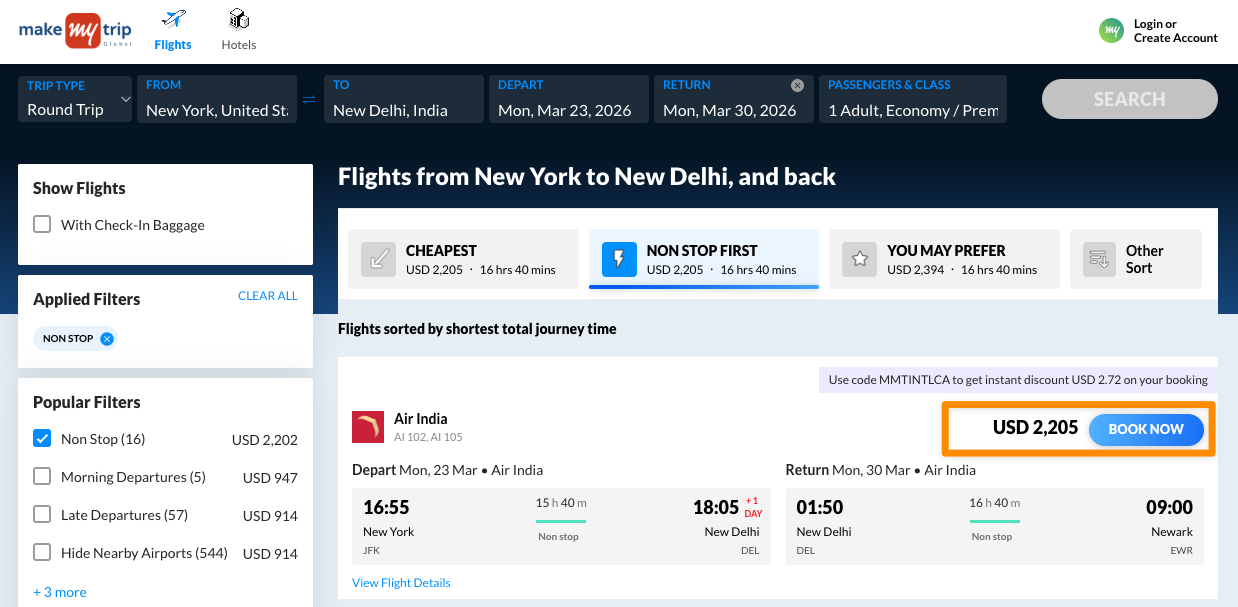
We proceeded to book the flight by entering all passenger information, accepting the conditions, and rejecting the insurance proposal. We then proceeded to a “Complete your booking” window showing the details of the flight, this window showed the initial price of $2,205.
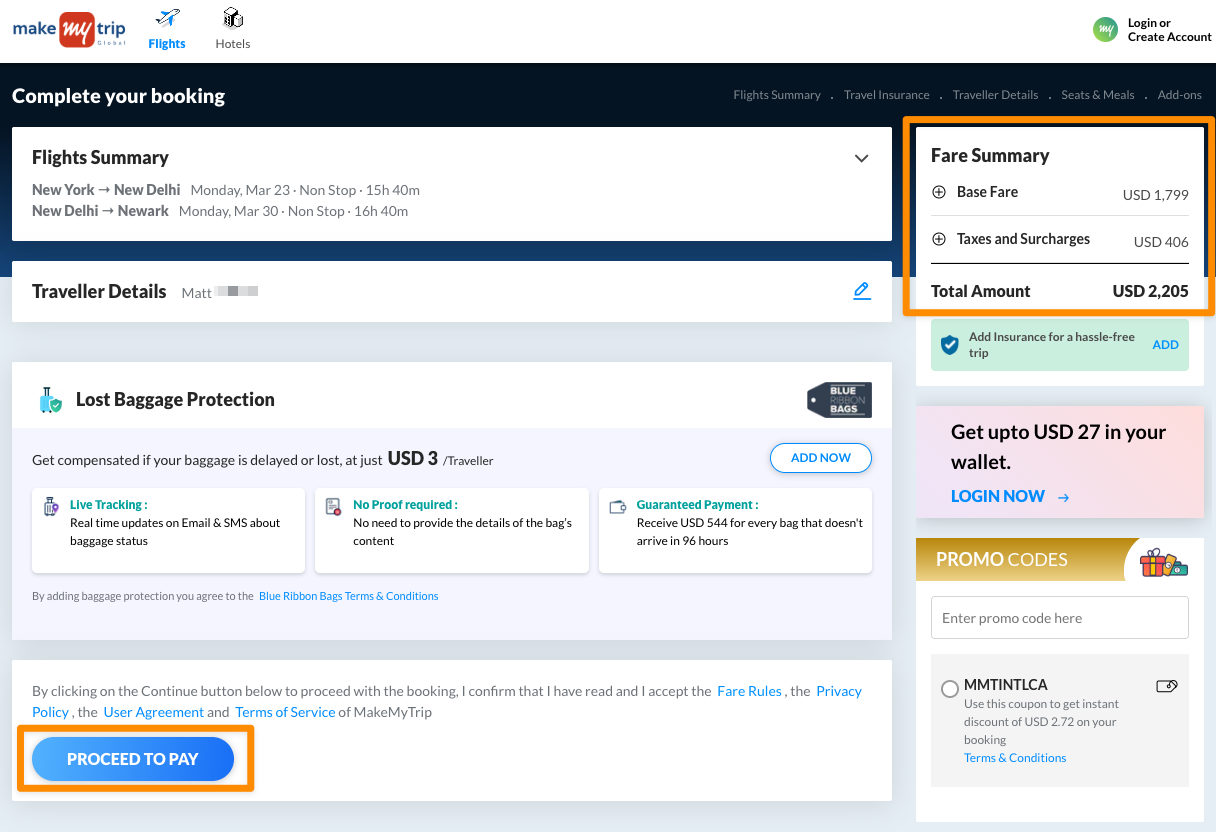
When we finally got to the checkout window, the price had increased to $2,232. The increase was due to a convenience fee of $27.23, equivalent to ~ Rs 2,500—more than what was reported in social media posts we previously mentioned.
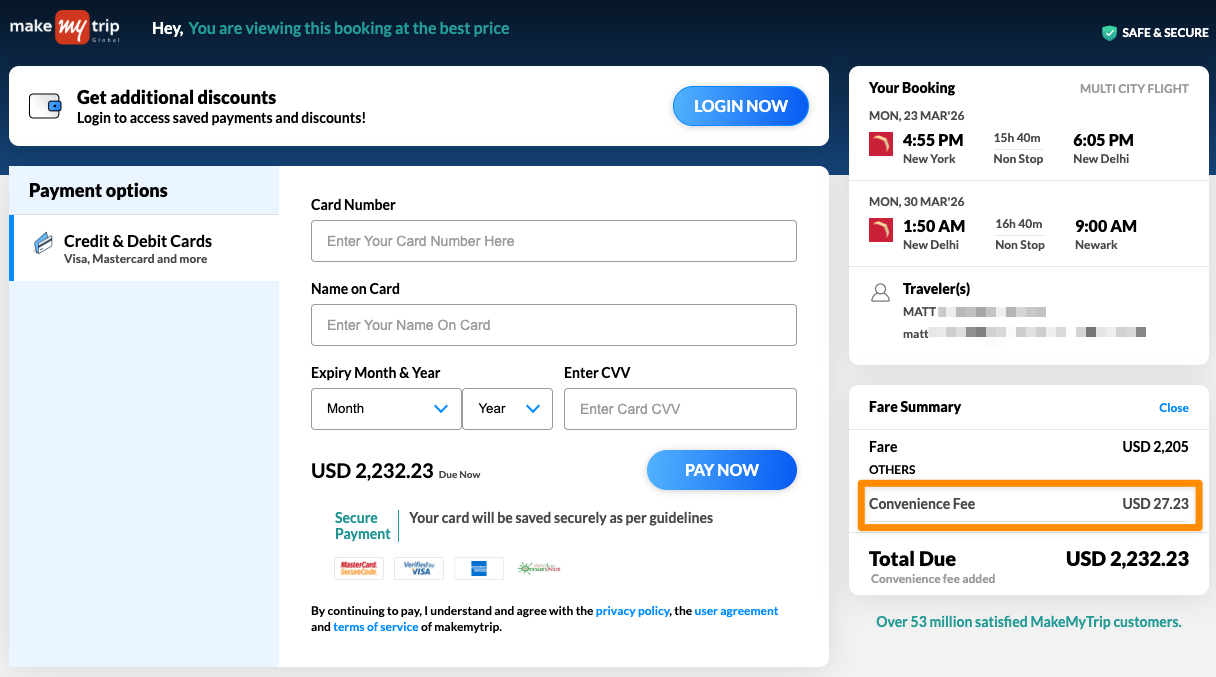
This practice appears to be explicitly rejected by other competitors in the market. For example Booking.com rejects this pattern, stating “No hidden fees - track your price at every step” during the booking process.
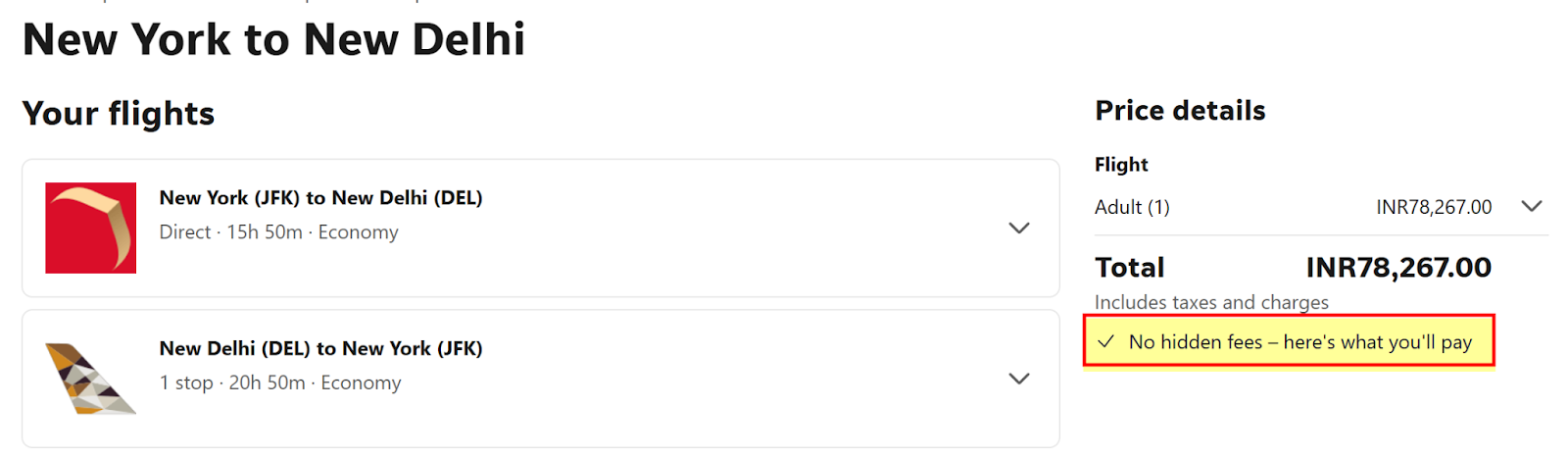
Dark Pattern Example #2: MakeMyTrip Uses Pressure Tactics And False Claims To Induce Customers To Buy Unnecessary Add-Ons Like Insurance
MakeMyTrip users have complained about a practice in which the company sends WhatsApp messages claiming that trip insurance is “mandatory.” One Reddit user claims to have been a victim of this tactic, calling it a “Scam by MakeMyTrip”.
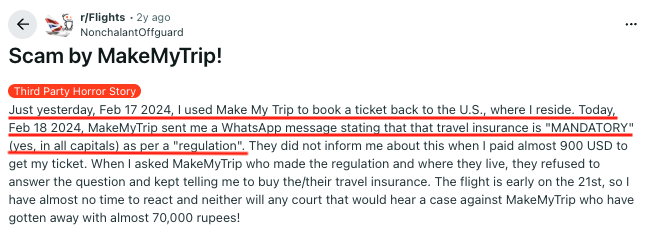
Another user also claims they were messaged about “mandatory” trip insurance after completing their booking, and even provided a screenshot of MakeMyTrip’s WhatsApp message.
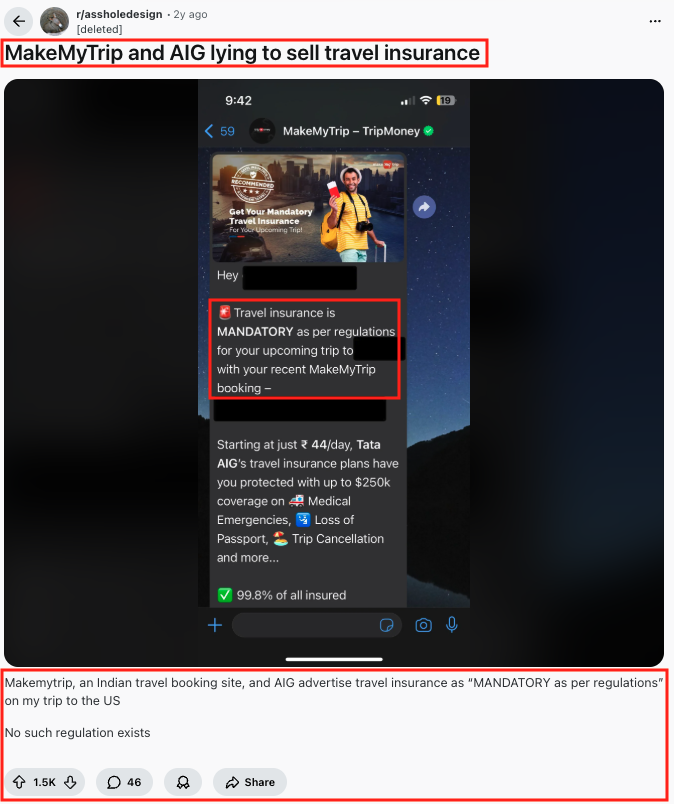
In a different post where a MakeMyTrip user shared their frustration around several fees, the most upvoted comment on this post was from someone claiming to be a former employee of MakeMyTrip who “coded some of those dark patterns that sell you insurance.” The comment appears to relate to the practice we just described.
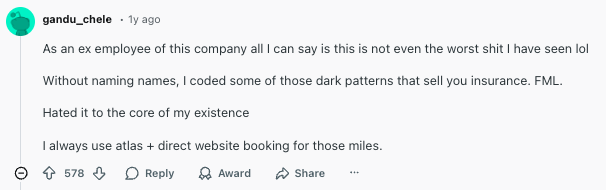
In another similar example, customers have reported that MakeMyTrip claims to have booked a cab for travelers after their flights, which appears to be another dark pattern aimed at tricking travelers into booking cabs from MakeMyTrip’s preferred partners.
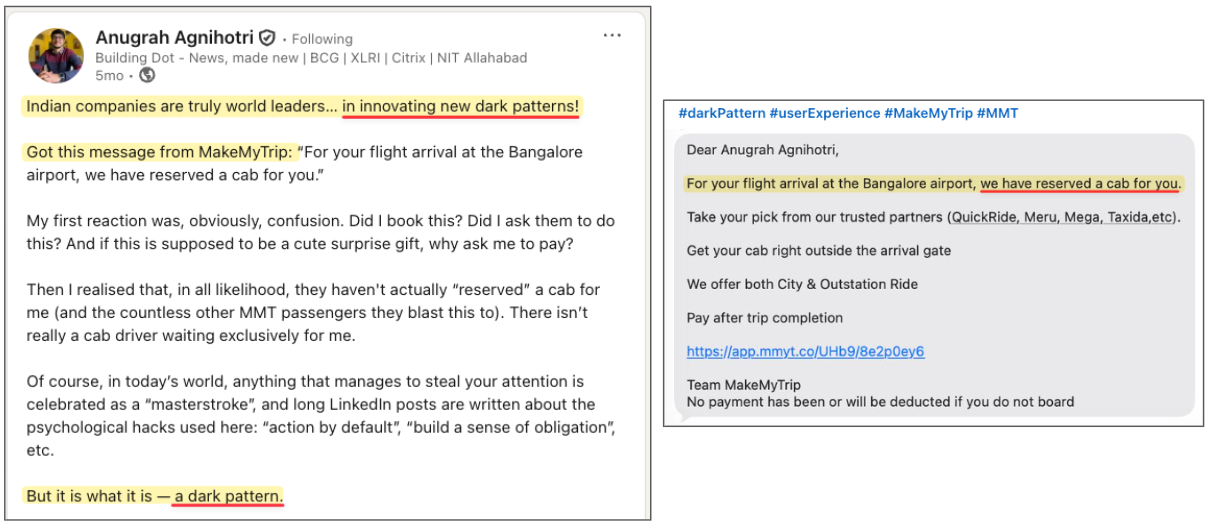
Dark Pattern Example #3: MakeMyTrip’s Train Segment Pushes A Paid Add-On Called “Alternate Trip”, Which Promises A “3X Refund” If A Ticket Is Not Confirmed
“Alternate Trip” Has Unclear Terms & Conditions That Make The Offering Virtually Worthless For Customers, And Claims That “Alternate Trip” Is A “Scam” Are Rampant Across Social Media
“So That [3X Refund] Is Also A Part Of, You Can Say, A Dark Pattern.” - Former Lead Engineer At MakeMyTrip
As mentioned, the Central Consumer Protection Authority (CCPA) of India defines dark patterns as any practice or deceptive design that is designed to mislead or trick users to do something they originally did not intend to do, including through the use of misleading advertising.
When using MakeMyTrip’s or RedBus for train travel, users are “recommended” to purchase an add-on known as the “Alternate Trip,” formerly referred to as “Seat Guarantee.” We believe that this scheme closely resembles the description of a dark pattern.
With this add-on, it appears as if a traveler will receive a “3X Refund” if their ticket is not confirmed due to certain quotas and excess demand, that will result in a waitlisted ticket without the possibility of boarding the train.
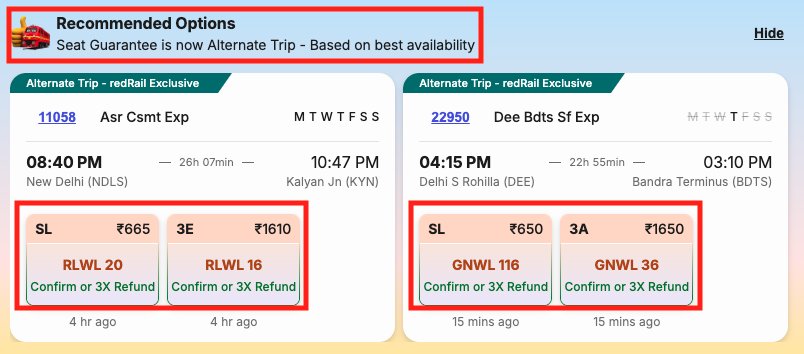
What is not clearly disclosed is that the Indian railway system already offers a full refund of the ticket cost if the ticket is never confirmed, per its own rules. In this way, MakeMyTrip is inducing customers to purchase something that they would, in part, already be receiving without the add-on.
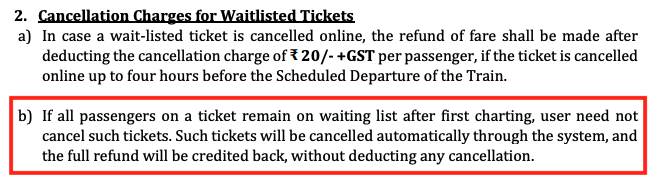
Above and beyond this basic refund that is already included with any train ticket, MakeMyTrip’s “Alternate Trip” guarantee includes an additional “travel voucher” worth 2x the fare cost, according to its marketing materials.
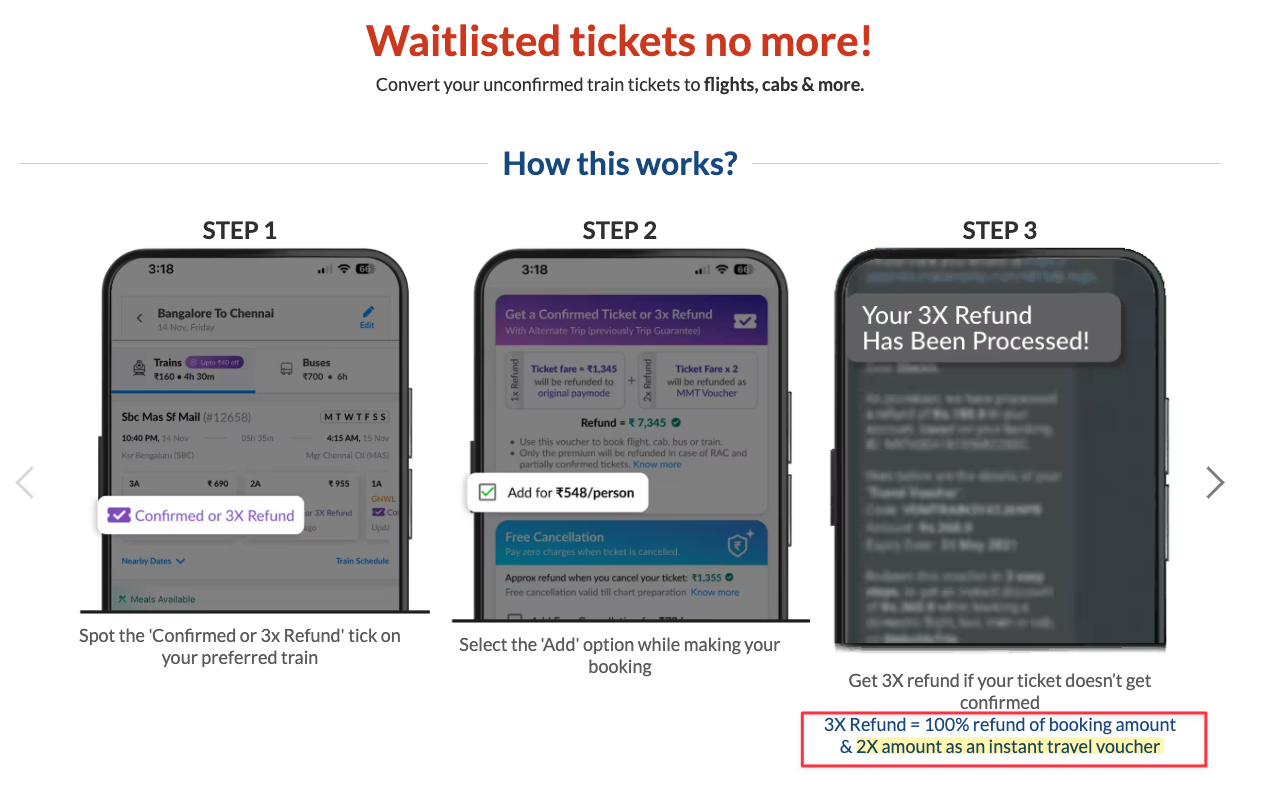
Moreover, MakeMyTrip buries many restrictions in its terms and conditions that, in our view, render the offering nearly worthless for consumers.
For example, one customer highlighted how the 3X Refund is null and void if a single ticket is confirmed in a group booking – even if the rest are not – and posted a screenshot of other restrictive terms and conditions. This prohibitive clause is not visible when customers purchase the Alternate Trip add-on, but is instead buried in MakeMyTrip’s terms and conditions.

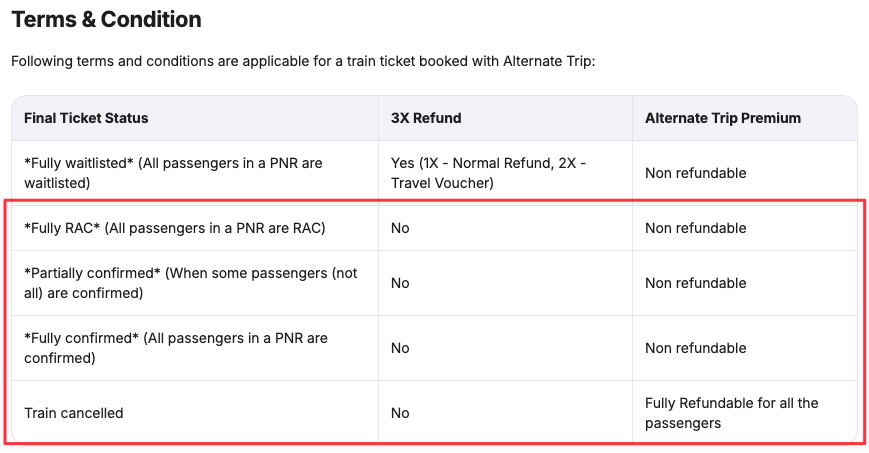
Adding to the small print, MakeMyTrip’s terms and conditions also include a maximum voucher value of 6,000 INR, equivalent to ~$65 USD. The voucher can not be freely used on all routes as it contains restrictions based on the original route.
Further, MakeMyTrip’s RedBus terms and conditions show that the 3X Refund does not apply if the train is canceled. In this case the premium paid will be refunded. We see this as the equivalent of an insurance company refunding your home insurance premium if your house gets burned down.
Across social media, MakeMyTrip’s customers have flagged the Alternate Trip “3X Refund” guarantee as a scam.
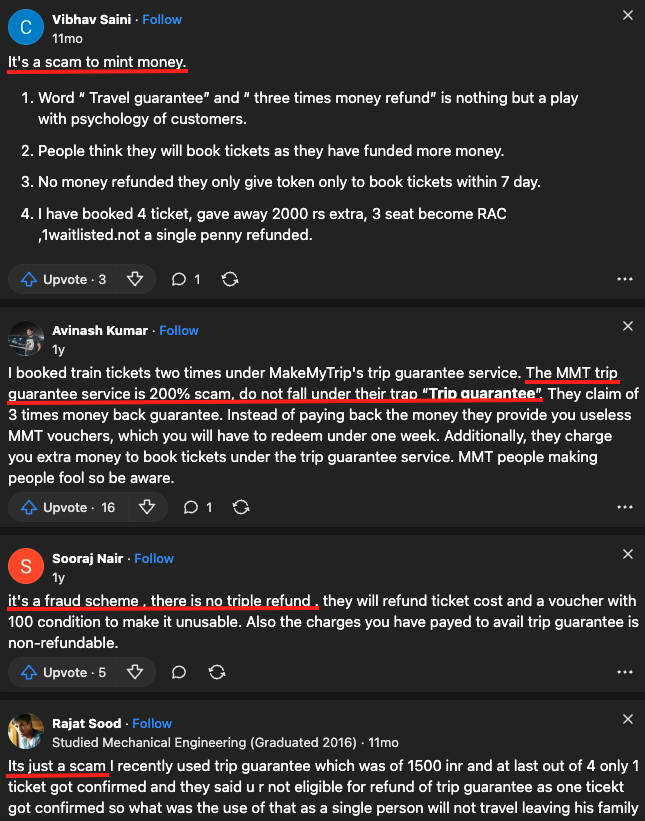
A Reddit user referred to Alternate Trip as a “scam” and highlighted the challenge in using the voucher within 7 days when it often takes longer than that to get a new trip confirmation.
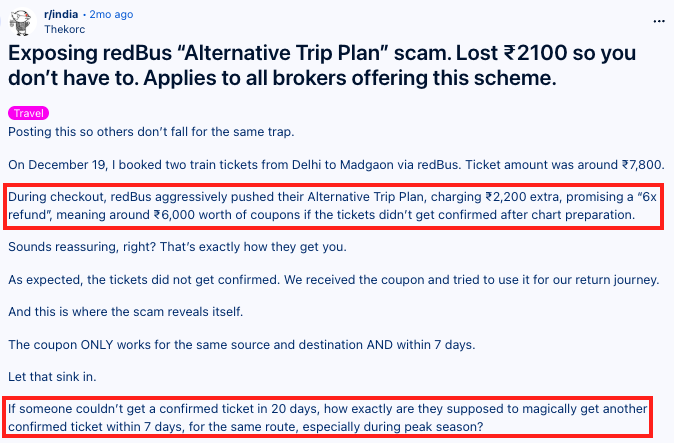
An X user called the add-on an “absolute sham,” saying the coupon “doesn’t work” for actual booking, while a review on TripAdvisor also stated that the “coupon will not work.”
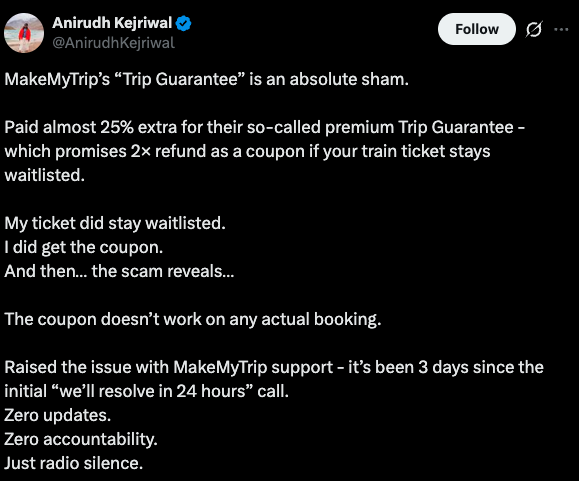
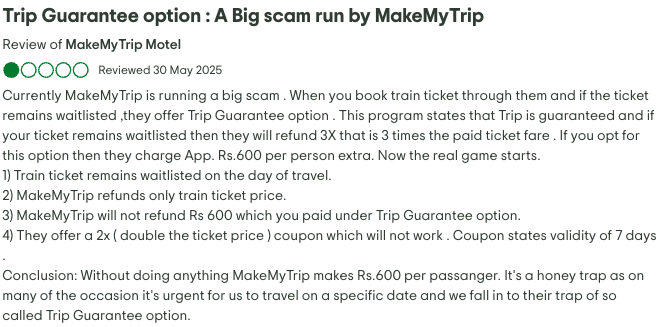
We believe MakeMyTrip’s train segment is utilizing an obvious dark pattern to sell an add-on product with extremely limited utility to customers. Former employees of MakeMyTrip’s also recognized this as a “dark pattern,” with a lead engineer telling us:
“So that is also a part of, you can say, a dark pattern, I would say. But yes, that's also part of marketing where you promise 3X refund, but it is not exactly the money that you're getting in hand.”
MakeMyTrip’s “Alternative Trip” guarantee appears to be another way that the company is extracting value from its customers, who often don’t understand the limited value of what they are receiving until it's too late.
MakeMyTrip Has Faced A Flurry Of Legal Cases, Scathing Online Reviews, And Social Media Backlash Related To Its Opaque Refund Procedures
A Summary Of 1700+ Online Reviews Reveals “Considerable Problems With Refunds” Including “Long Delays” And The “Outright Denial” Of Refunds
Last month, MakeMyTrip was fined for “deficient services” and for giving “false assurances” relating to a years-long dispute where a customer was seeking a refund for a cancelled flight from March 2020, which the customer was ostensibly unable to obtain without litigation, according to Tribune India, a local news publication.
In another recent case, MakeMyTrip was ordered to refund a customer after cancelling his honeymoon trip one day before his scheduled departure. Prior to legal intervention, MakeMyTrip allegedly "outrightly refused” to refund the customer, according to a local newspaper, The Indian Express
In a third recent case, MakeMyTrip was found guilty of “deficiency in service” for failing to pass along a full refund to a customer when his flight was cancelled, according to The Telegraph India
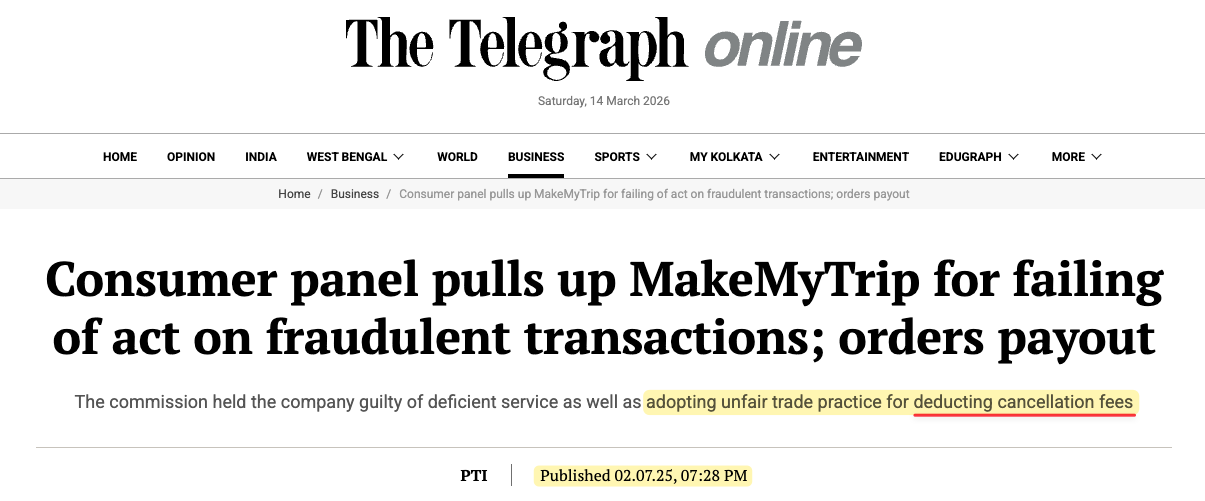
While these cases may seem anecdotal and the penalties immaterial, we believe they signal a potentially broader issue with MakeMyTrip’s refund procedures, as evidenced by the immense criticism of the company across social media.
In one example, last December, an Indian journalist documented the process of requesting a flight cancellation until MakeMyTrip’s Goibibo initiated a refund. [1, 2]
After five days of initiating the cancellation request, he contacted the airline directly to ask for the flight cancellation, for which he obtained confirmation that the airline had issued a refund to Goibibo in the amount of Rs 1,477.
13 days after his initial request, Goibibo initiated the refund of only INR 6, representing less than 1% of the amount that the airline had refunded to Goibibo, according to the confirmations shown by the journalist on X. [1, 2]
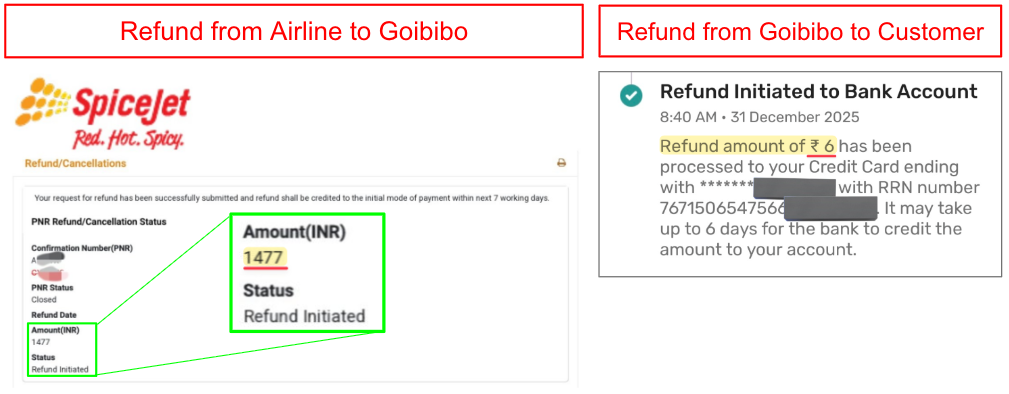
Another customer stated on LinkedIn that SpiceJet offered him a refund for a cancelled flight, but that MakeMyTrip only passed on “less than half” of that amount, stating that MakeMyTrip holds onto customer refunds in a “black box.”
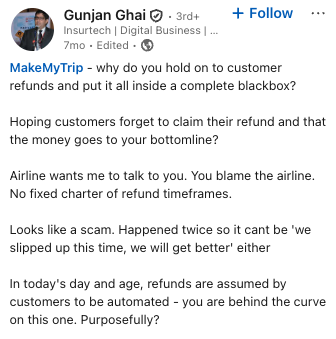
Another user claimed on X, that his airline, Indigo, issued a full refund when his flight was cancelled, but MakeMyTrip kept 60% of the refund for itself.
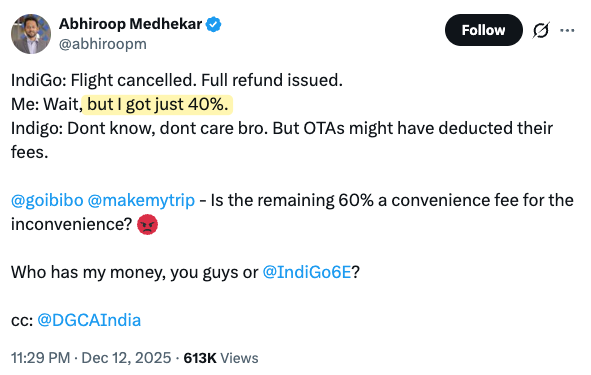
In another example, in January 2026, an Indian journalist had her flight rescheduled for a full day earlier, and when she went to cancel it, MakeMyTrip retained its seat selection fee, its convenience fee, and a “cancellation fee.”
As of this writing, TrustPilot features 1,816 reviews for MakeMyTrip that average 1.2 stars. While negative reviews are common for OTAs, TrustPilot’s “AI Summary” of the 1700+ reviews highlights “considerable problems with refunds” that include “long delays” or the “outright denial” of customers getting money back.
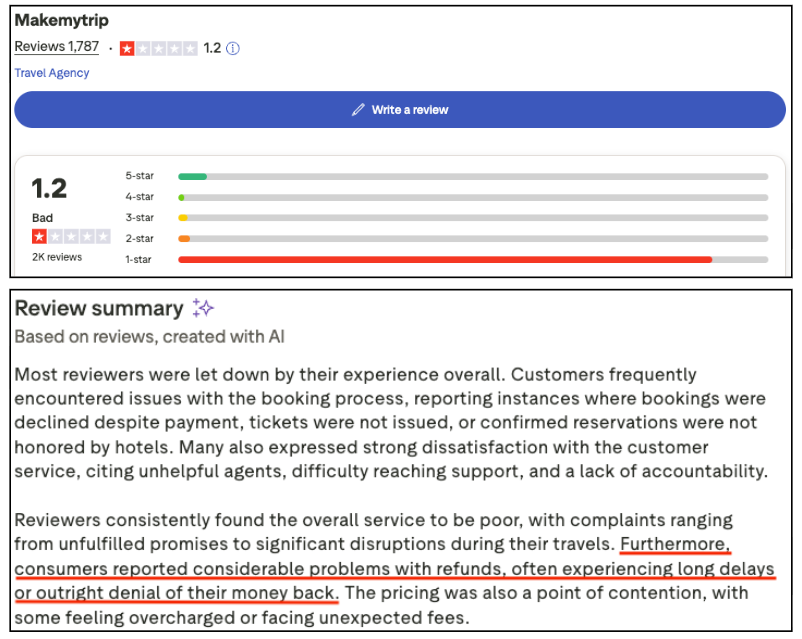
MakeMyTrip’s refund procedures appear woefully inadequate at best and potentially predatory, while further degrading its customer experience.
Conclusion
MakeMyTrip’s founders have frequently extolled the business’s “moat.” This moat feels to us more like its willingness to arm-twist India’s vast and independent hotel landscape. As a result of many of these anti-competitive practices, it appears that MakeMyTrip now faces further regulatory scrutiny from the Indian government.
At the same time, deep-pocketed peers, including its own strategic investor Trip.com, global peers like Booking.com and Agoda, and domestic OTAs are eroding share in multiple verticals. Something which management seems to deny. Market forces will eventually move consumers to safer offerings and away from deceptive practices in the form of dark patterns.
We believe that as the depth of its moat is challenged and anti-competitive practices come to light, MakeMyTrip’s newly found profitability will soon be eroded to a point where even adjusted metrics and accounting gimmicks will fail to deliver an appearance of growth.
Disclosure: We are short shares of MakeMyTrip Limited (NASDAQ:MMYT)
Legal Disclaimer
Use of Morpheus Research LLC’s (“Morpheus Research”) research is at your own risk. In no event should Morpheus Research or any affiliated party be liable for any direct or indirect trading losses caused by any information in this report. You further agree to do your own research and due diligence, consult your own financial, legal, and tax advisors before making any investment decision with respect to transacting in any securities covered herein. You should assume that as of the publication date of any short-biased report or letter, Morpheus Research (possibly along with or through our members, partners, affiliates, employees, and/or consultants) may have a position in the stock, bonds, derivatives, or securities covered herein and therefore stands to realize significant gains if the price of the securities move. Following publication of any report or letter, Morpheus Research intends to continue transacting in the securities covered therein and may be long, short, or neutral at any time thereafter regardless of Morpheus Research’s initial position or views. Morpheus Research’s investments are subject to its risk management guidance, which may result in the de-risking of some or all its positions at any time following publication of any report or letter depending on security-specific, market or other relevant conditions. This is neither an offer to sell or a solicitation of an offer to buy any security, nor shall any security be offered or sold to any person, in any jurisdiction in which such offer would be unlawful under the securities laws of such jurisdiction. Morpheus Research is neither registered as an investment advisor in the United States, nor does it have similar registration in any other jurisdiction. To the best of Morpheus Research’s ability and belief, all information contained herein is accurate and reliable and has been obtained from public sources believed to be accurate and reliable, and who are not insiders or connected persons of the stock covered herein or who may otherwise owe any fiduciary duty or duty of confidentiality to the issuer. Conclusions expressed herein are based upon the information disclosed herein and represent the opinion of Morpheus Research. Such information is presented “as is,” without warranty of any kind – whether express or implied. Morpheus Research makes no representation, express or implied, as to the accuracy, timeliness, or completeness of any such information or with regard to the results to be obtained from its use. All expressions of opinion are subject to change without notice, and Morpheus Research does not undertake to update or supplement this report or any of the information contained herein.
Appendix A — Customer Review Analysis
We hired an IT company to scrape reviews from MakeMyTrip’s website for all hotels in the 0-4000 INR category for Bangalore, Delhi and Mumbai. We also included additional reviews from GoIbibo’s website. In total we obtained reviews from 3679 hotels.
We then analyzed the reviews for at least 1 review for issues like extra, hidden or fraudulent payments being asked at the property; women’s safety concerns or likely illegal or shady conduct.
We have compiled our findings in the following document, where we limited the number of reviews to a maximum of 3 - some properties have many more.
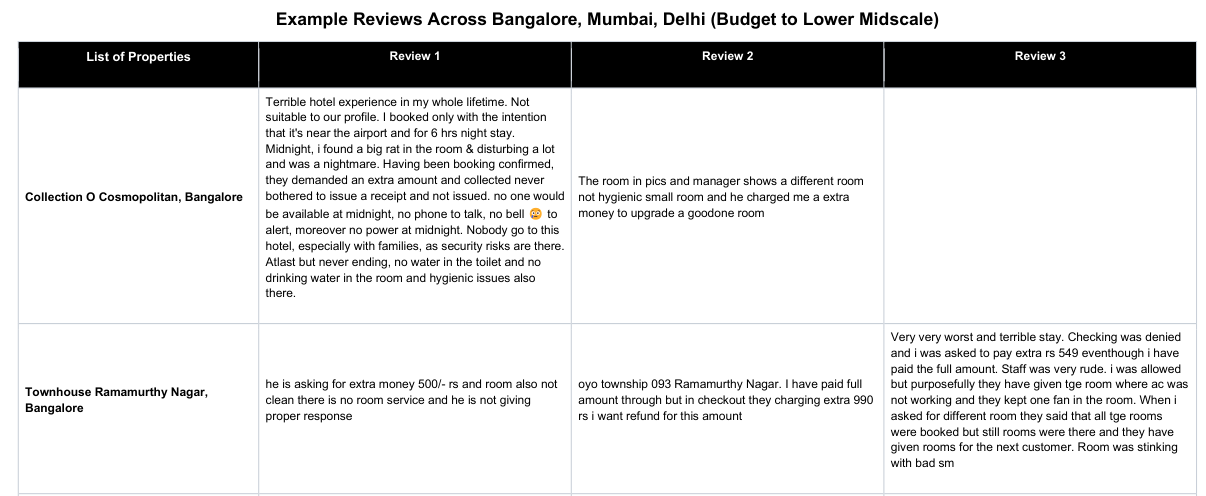
Specifically for women’s safety issues, we identified properties with at least one review on MakeMyTrip or GoIbibo with a women’s safety issue or concern. This yielded 43 properties for Bangalore, 41 properties for Delhi and 29 for Mumbai. [1, 2, 3]